The alleyways of the lower Ariphe did not smell of cosmic energy; they smelled of Malrik’s own skin—stale wine, cold smoke, and the sharp, metallic tang of iron. He leaned against the damp stone wall, his slouched, five-foot-ten frame blending seamlessly into the soot-choked shadows. To any passing traveler, he looked like nothing more than a weary, common man. But the aura radiating from his bent shoulders told a different story. Around him, the very bricks seemed to lose their color, bleeding into a uniform, suffocating grey. The Decay Aura was a slow poison, a reflection of the heavy, toxic atmosphere of a mind trapped entirely within a closed loop.
He closed his eyes, and the dull crimson glow beneath his lids began to pulse. Inside his mind, the circuit fired. It always started with the comparison. He thought of Lucian—the golden child, the innocent, walking through the upper planes with a posture unburdened by gravity. Why him? the whisper grew in Malrik’s chest, fueled by ancient envy. What makes his light cleaner than mine?
To escape the bitter cold of his own insignificance, Malrik reached for his power. He found a young traveler stumbling down the alley, eyes wide with the fragile hope of ascension. Malrik smiled—a sly, joyless curl of his lips that never reached his murky grey-brown eyes. He didn’t use a blade. He used the Whispers of Temptation.
“He won’t wait for you at the gate,” Malrik murmured, his voice sliding into the traveler’s ear like oil. “The pure ones always leave the ordinary behind. Save yourself. Take what’s yours before he drops you.”
As the seeds of doubt took root, the traveler’s face hardened with envy. In that precise moment, Malrik felt it—the intense, artificial apex. A massive, simulated surge of triumph flooded his system, a counterfeit dopamine spike that mimicked the true sovereignty of the upper realms. For a fleeting second, Malrik felt large. He felt remembered. He felt like a god ruling over a domain of shadows.
But the counterfeit light never lasted. The high cracked, shattered by the rigid laws of the Maziramy. As the traveler drifted away, poisoned and isolated, the environment hit back. The temporary expansion collapsed into acute contraction. The stress circuits of the lower plane activated, flooding Malrik’s veins with the energetic equivalent of dynorphin and CRF.
A profound, hollow dysphoria settled into his chest. The murky grey rings under his eyes throbbed with a physical, bruising ache. The fleeting pleasure was entirely gone, leaving behind only a ravenous, survival-driven desperation. He hated the smoke. He hated the wine. He hated the very words he spoke to destroy others, yet the hunger to repeat the cycle clawed at his throat. He was running from his own reflection, desperately trying to outrun the pain of a stagnation he had chosen for himself.
Malrik tried to look upward, toward the higher Ariphes where the architecture of the universe was still bright and deliberate. He wanted to think his way out, to plan an ascent, to remember the face of God before he had fallen this far. But his prefrontal cortex—the throne of his individual sovereignty—was dark, rendered hypoactive by the sheer weight of his habits. The reflective system failed. He couldn’t formulate a long-term strategy; his mind was entirely hijacked by the stimulus-driven impulses of the dorsal striatum.
He was no longer a free man making choices; he was an automated construct of his own cynicism. When he looked at his hands, he didn’t see tools for creation. He saw gaudy, cheap imitation rings scraping against worn jeans. He was trapped in the preoccupation stage, his thoughts entirely consumed by the anticipation of the next target, the next betrayal, the next small coin that would temporarily quiet the screaming void of his insignificance.
“A chronic, relapsing disease of the soul,” Malrik muttered to the empty alley, his bitter humor turning inward as he mocked his own powerlessness. He adjusted his hooded coat, pulled the shadows tightly around his slouched shoulders, and slunk deeper into the lower realms. He was the Everybad. He had traded his sword for a whisper, and the loop was tightening.
The sound of the loop was broken not by a step, but by the settling of a murder of crows upon the soot-choked gutters above.
Malrik paused, his hand frozen against the damp stone of the alley, his fingers twitching against the gaudy, imitation brass of his rings. The uniform grey of his Decay Aura suddenly encountered an immovable boundary. From the mouth of the alleyways where the shadows thickened into a dense, ink-like fog, an immense pressure rolled inward. It smelled of scorched earth, ancient parchment, and the terrifyingly pure scent of ozone.
Then came the silhouette: tall, broad-shouldered, and standing at a commanding six-foot-three, cutting through the grey mist like a split vein.
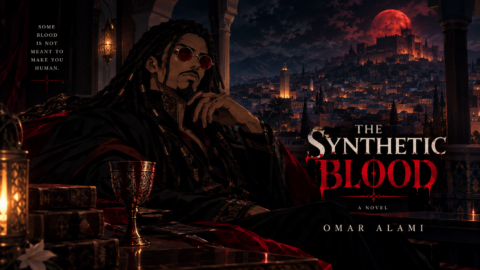
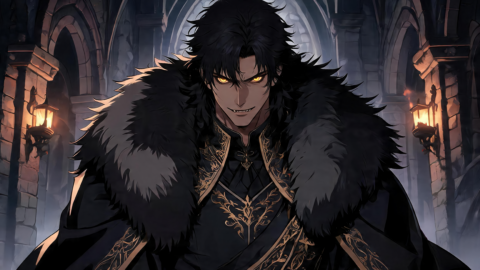
It was Zarak. His long, ashen dreadlocks hung wild with a silver sheen under the dim light, framing a hardened, sharpened jawline and eyes sunken from sleepless discipline. A black and blood-gray cloak trailed behind him, moving dynamically like living smoke, shifting to reveal a sleeveless tunic lined with crimson thread. Over his brow sat the faded black bandana, its white Yin-Yang symbol centered perfectly like a cold eye watching the dark. His aura didn’t bleed like Malrik’s; it pulsed—a violent, crimson-black mist that wrapped around his muscular arms like ethereal armor. To anyone looking from the outside, he was the absolute manifestation of an unbridled, ruthless villain, a monster driven by an insatiable hunger for dominion.
Malrik slouched deeper into his coat, his murky grey-brown eyes flickering with a defensive, dull crimson glow. He felt the vast disparity in power, his survivor’s cunning instantly searching for a vulnerability, an insecurity to exploit.
“You look lost, giant,” Malrik spat, his voice dropping into the low, oily cadence of his Whispers of Temptation. “The kings of the upper planes don’t usually send their prized hunters down into the dirt. Or did they kick you out? A beast like you belongs in a cage, not walking the Ariphes pretending you own the night. They’re afraid of you up there. They’ll betray you the moment your back is turned. I know their kind.”
Zarak stopped. He did not draw a weapon from his layered leather belts, nor did he unleash the daggers sheathed at his sides. Instead, he slowly turned his head sideways, allowing his single exposed crimson eye to pierce through the gloom, locking onto Malrik with a stare that felt like it was unravelling the very fabric of the Everybad’s soul. On his left ear, a metallic fang earring caught the dim light.
A slow, cryptic half-smile crept onto Zarak’s face—a smirk that carried the heavy, bittersweet weight of immense pain and ancient wisdom.
“You speak of cages, little mirror, while you rattle the bars of your own,” Zarak’s voice resonated through the alley, deep and steady, devoid of the petty malice Malrik expected. “You look at this mist, you see these scars, and you think you recognize the dark. You think because I walk looking like the end of the world, I am driven by the same cheap hunger that rots your bones.”
Zarak took a single step forward, his sand-scorched boots echoing with a terrifying finality. The crimson-black mist around him expanded, pushing Malrik’s suffocating grey aura back until the bricks themselves seemed to tremble. The fragment of a broken mirror hanging from Zarak’s neck caught a stray beam of light, flashing brilliantly against his chest.
“You observe the lower realms and call it fate,” Zarak continued, his burning eye glowing brighter, fixed on Malrik’s slouched form. “You whisper doubt into the ears of travelers because your own prefrontal sovereignty is dead. You have no long-term vision, only the immediate, desperate itch of the striatum. But do not mistake my chaos for your corruption. I carry the weight of the shadow, I wear the skin of the adversary, but my heart is anchored to the One who split the light from the dark.”
Malrik flinched, his Weakness Reflection failing to find purchase against Zarak’s absolute internal alignment. He looked for fear, he looked for greed, he looked for the hypocritical pride of the righteous—but beneath Zarak’s terrifying, villainous exterior lay an unyielding, secret faith that kept the beast entirely under command. Zarak was playing a completely different game; he was a combat philosopher holding the line between his own internal heavens and hells.
“You are nothing but an automated loop, Malrik,” Zarak murmured, his shadow momentarily moving independently against the cracked marble of a ruined archway behind him, expanding like a giant wing. “A warning written in the margins of the Maziramy. You chose the shadow for a handful of imitation gold, while I conquered the shadow to keep it from consuming the throne.”
Zarak reached up, adjusting his faded bandana with a steady, calloused hand, then looked past Malrik toward the distant crescent moon hanging over the upper planes. The intensity of his aura suddenly receded, shifting back into a calm, meditative silence that left the alleyway feeling twice as cold as before.
“Ascend, or drown in your repetition,” Zarak said quietly, turning his back to vanish into the deep fog. “The Ladder does not wait for those who love their chains.”
Malrik stood alone in the quiet dark, his breath ragged, the cheap rings on his fingers suddenly feeling heavy enough to break his hands. The loop was still there, but for the first time, the Everybad knew exactly how small it was.
The silence Zarak left behind was louder than the crows.
Malrik remained frozen under the ruined archway, his murky eyes staring at the empty space where the crimson-black mist had just evaporated. The suffocating grey of his own aura crept back slowly, reclaiming the damp stone, but it felt thin now—diluted, like wine cut with too much water. His fingers twitched against the gaudy, imitation brass of his rings. For the first time in cycles, the automatic machinery of his mind had ground to a halt.
Zarak’s words had not just insulted him; they had diagnosed him. An automated loop.
A sudden, violent surge of panic hit his chest—the raw, unmedicated friction of the withdrawal stage. Without the immediate dopamine spike of a successful manipulation, the neural circuits of the lower Ariphe began to starve. The dysphoria was physical, a heavy weight pressing behind his eyes, demanding a reaction. The survivor’s cunning inside him, usually so fluid and slick, scrambled in the dark like a cornered beast.
He had two choices, and the Ladder was watching.
For a fragile, agonizing heartbeat, a crack formed in Malrik’s cynicism. The memory of Lucian’s unburdened posture flashed through his mind, no longer provoking envy, but a hollow, desperate longing. He looked down at his calloused hands, at the worn jeans and the sand-scorched dirt. He could stop. He could pull his slouched shoulders back, face the agonizing burn of his own neurochemical baseline, and begin the slow, grueling extraction of his soul from this plane. He could gather the baseline currency—the personal capital of honesty, the social capital of a broken confession—and take the first step toward the threshold.
But the prefrontal cortex was too dark. The reflective system, neglected for years in favor of the easy, stimulus-driven path, lacked the structural mass to hold the vision. The habit was a gravity well, and Malrik’s baseline was entirely defined by escape.
The crack snapped shut, sealed over by a hard, freezing layer of spite.
“Anchored to the One,” Malrik whispered into the fog, mocking Zarak’s cadence, though his voice shook. “Pretending your chains are holy just because you wrapped them in verses. You’re still in the dirt with me, giant.”
The desperation turned venomous. If he could not ascend to challenge Zarak’s philosophy, he would deepen his roots in the lower planes until he grew large enough to pull the giant down. He couldn’t do it alone; his own power was a slow decay, a poison that required time to fester. He needed a catalyst—an alliance with something native to the deep architecture of the loop.
Malrik turned away from the distant crescent moon, turning his back completely on the upper Ariphes. He pulled his hooded coat tightly around his jawline and slunk deeper into the narrowing veins of the slum, where the soot turned to black sludge.
He stopped before a subterranean iron grate, beneath which the liquid waste of the realm churned in absolute darkness. He knelt, his gaudy rings scraping against the bars as he reached his hands into the cold, rising vapor. This was the place where the accumulated despair of a thousand failed ascents gathered—a localized entity of pure, unrefined craving.
“I have a name for you,” Malrik whispered down into the grate, his dull crimson glow flaring into an unstable, jagged spark. “A fierce shadow with an ashen mane and a broken mirror on his chest. Help me break his alignment, and I will feed this entire tier to your hunger.”
From the depths of the iron drain, the sludge rippled. A low, subterranean vibration hummed through the soles of Malrik’s boots, answering him. The loop wasn’t breaking; it was expanding, preparing to swallow the next traveler whole.
The subterranean hum beneath the iron grate grew into a rhythmic, pulsing throb that vibrated through Malrik’s sand-scorched boots. It was the heavy, automated frequency of the lowest tier, a perfect magnification of the dorsal striatum’s unyielding demand. The black sludge rippled upward, clinging to his fingers like liquid velvet, coating his cheap imitation rings in a dull, void-like sheen.
He didn’t pull back. As the entity of pure craving merged with his own Decay Aura, the crushing weight in his chest transformed. The hollow dysphoria of his withdrawal was replaced by a cold, synthetic surge of power—a weaponized obsession designed to shatter the reflective sovereignty of anyone who crossed his path.
Malrik pulled his hood low, his murky eyes now burning with a sustained, jagged crimson light. He knew exactly where to set the trap.
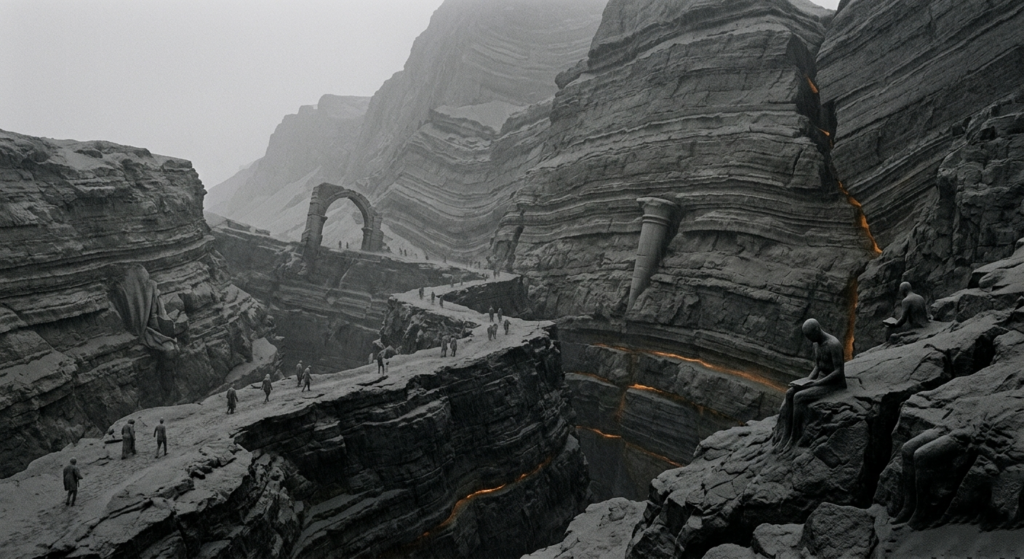
At the crossroads where the lower slums bled into the white marble ruins of the middle Ariphe, the air was clear, lit by the distant, steady glow of the crescent moon. This was the threshold where travelers gathered their strength to ascend.
Among them was an initiate close to Lucian’s circle—a young scribe carrying a heavy leather scrollcase, his face bright with the disciplined focus of a mind oriented toward higher ideals. He was practicing the silent, meditative breath that kept the impulsive system at bay, his posture erect, his alignment clean.
Malrik stepped from the soot-choked archway, his slouched posture carefully exaggerated to look entirely helpless. The black sludge on his hands was hidden beneath his pockets, but the air around him grew instantly cold, the colors of the nearby marble dulling to an ash-grey.
“You’re wasting your breath, boy,” Malrik murmured, his voice laced with the augmented venom of his new alliance. The Whispers of Temptation didn’t just drift into the air; they hung like heavy smoke, wrapping around the scribe’s head. “You think that steady breathing will save you when the higher planes look down? I saw your friends up there. I saw Lucian.”
The scribe paused, his prefrontal control wavering for a fraction of a second at the mention of the name. “The pure do not abandon the seeker,” the young man replied, though his voice lacked its initial core stability.
“They don’t abandon the heroes,” Malrik sneered, taking a slow, slouched step forward. His gaudy rings flashed, reflecting a distorted, mocking vision of the scribe’s deepest secret fear—the fear of being left behind in the dark, unacknowledged and forgotten. “But you aren’t a hero. You’re a clerk carrying their luggage. Lucian walks with Zarak now. The giant with the ashen dreadlocks who looks like a demon but speaks like a saint. They don’t have room on the Ladder for a boy who struggles just to breathe in the grey.”
The Weakness Reflection hit with the precision of a scalpel. The black sludge beneath the grate surged in tandem with the scribe’s sudden, internal chaos. The young man’s shoulders slouched. The automatic, impulsive system of his brain flared to life, triggered by the acute threat of social isolation and insignificance. The fast, emotional circuitry overrode his slow, deliberative reflection.
“They… they left the gate closed behind them?” the scribe whispered, his eyes clouding with the exact same murky distrust that defined Malrik’s existence.
“They always do,” Malrik hissed, his sly smirk finally breaking through the shadows.
The trap was fully sprung. The scribe’s alignment shattered, his internal universe tipping violently toward the impulsive loop. The brilliant light of the middle plane faded from his aura, replaced by the heavy, suffocating grey of the lower tier. He didn’t look up at the crescent moon anymore; his gaze dropped to the dirt, his mind entirely hijacked by the sudden, desperate need to protect himself, to envy, to survive.
From the shadows of the higher ridge, a single crow took flight, its dark wings cutting across the moon. Zarak’s warning echoed in the empty spaces of the alleyways, but Malrik didn’t care. He stood over the fallen initiate, bathing in the counterfeit surge of the triumph, his loop wider now, his hunger sated for one more night in the dark.