What follows was not written. It was accumulated — gathered from the residue left by those who crossed, from the testimonies of those who returned, and from the silence of those who did not. The Ariphes does not explain itself. It does not need to. It has been here longer than the question of how it came to be, and it will remain long after that question stops being asked.
Read this as you would read a wound: carefully, and with the understanding that the information it contains was purchased at a price you did not pay.
I. TOUKHLAT
The Kingdom of Man
Toukhlat does not greet you. It has never greeted anyone. It simply continues — the way stone continues, the way geological time continues — indifferent to your arrival in the manner of something so vast it cannot register the scale of a single consciousness appearing at its edge.
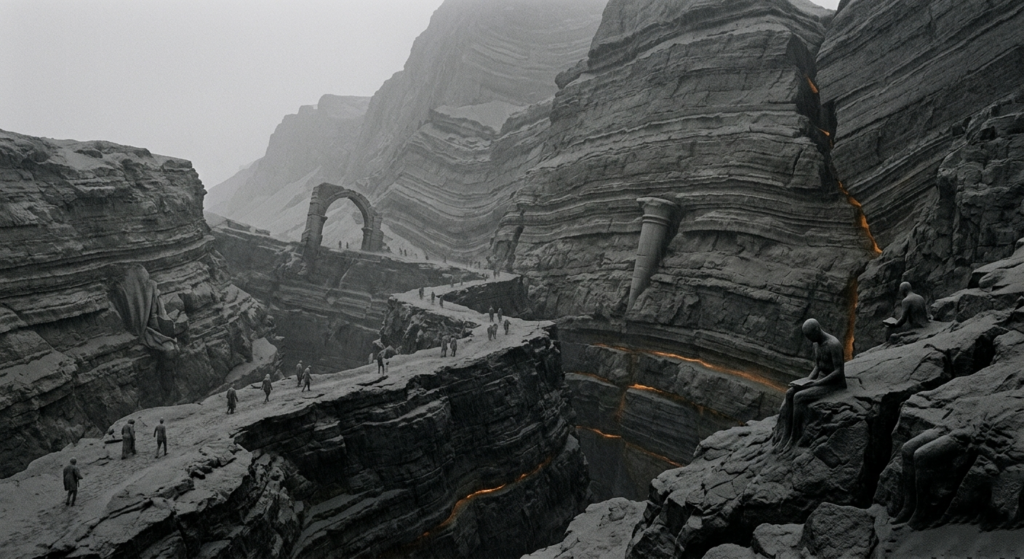
You will feel it before you see it. A heaviness behind the sternum, as if the air has decided to cost something. Then the light — what passes for light here — a grey so complete it feels less like an absence of color and more like a color that gave up. The mountains do not rise so much as accumulate, layer upon compressed layer of hardened time, pressing down with a patience that makes ambition feel briefly absurd.
The ash falls. It has always been falling. Each flake takes what feels like centuries to land, coating every surface in a fine grey forgetting. There is no wind to disturb it. There is only the sound, if you listen long enough, of the stone settling further into itself — a sound so low it registers in the jaw rather than the ear.
Beneath you — beneath all of it — something moves. Not quickly. Not urgently. A pulse in the deep rock, amber and slow, tracing corridors through the basalt that no geological process produced. These are the ley-lines, and they are the oldest things in the Ariphes. They do not belong to Toukhlat. They belong to whatever Toukhlat used to be, before it forgot.
The ruins you pass are not ruins of buildings. They are ruins of intentions — the crystallized remains of systems of belief that collapsed under the weight of their own unexamined assumptions, preserved perfectly in the basalt like insects in amber. A broken archway here that was once a philosophy. A half-buried pillar there that was once a principle someone organized an entire civilization around. They are not tragic. They are instructive, if you can read stone.
Toukhlat asks one question of everyone who enters it, and it asks it without words, without ceremony, through the simple relentless pressure of its existence: Why are you still here? Not as a challenge. As a genuine inquiry. The answer you give — not in speech but in the quality of your continued movement — determines whether the ley-lines ever make themselves visible to you.
Most who enter Toukhlat never find them. They feel the weight, they endure the ash, they survive the grey — and they call that enough. They are not wrong that it is a form of passage. They are wrong that it is the only one available.
The ones who find the ley-lines are the ones who stopped treating the stone as an obstacle and began reading it as a text. Who understood that the weight pressing down on them was not hostile but informational — that every layer of compressed time in the basalt was a record of something that tried to rise and fell back, and that the record was worth more than any surface easily traversed.
Toukhlat does not reward this understanding. It simply allows the next thing to become visible.
Those who dwell here longest are the ones who have partially merged with the basalt itself — scholars of the deep record, their lower bodies indistinguishable from stone, spending centuries in the patient work of reading what the ruins say. They are not trapped. They chose this. They are the only beings in Toukhlat who are never surprised by anything, because they have read enough endings to understand that continuation is always stranger and more demanding than the ending would have been.
The others — the vast majority — move through Toukhlat in the grey light, going about the mechanics of physical existence with varying degrees of grace. Some of them, the ones who live closest to the hairline cracks in the basalt, occasionally feel something they cannot name rise up through the soles of their feet. They pause. They look down. They almost ask the question. Then the moment passes, and they continue.
Toukhlat watches all of this with the patience of something that has seen it before and will see it again and finds, in the repetition, not boredom but a quality of attention that other realms would call love, though Toukhlat would not use that word.
Toukhlat does not use words. It uses weight.
What lies above Toukhlat is not escape. It is context. The stone you carry out of here — the density you metabolized, the record you read — becomes the anchor that keeps the higher realms from dissolving you.
II. DOSEY
The Subconscious Stream
There is no shore. You do not arrive at Dosey from a direction — you simply find yourself in it, as if the transition from Toukhlat was less a crossing than a remembering, the sudden awareness that this place was always underneath the one you just left, waiting with the patience of everything that has been waiting to be looked at.
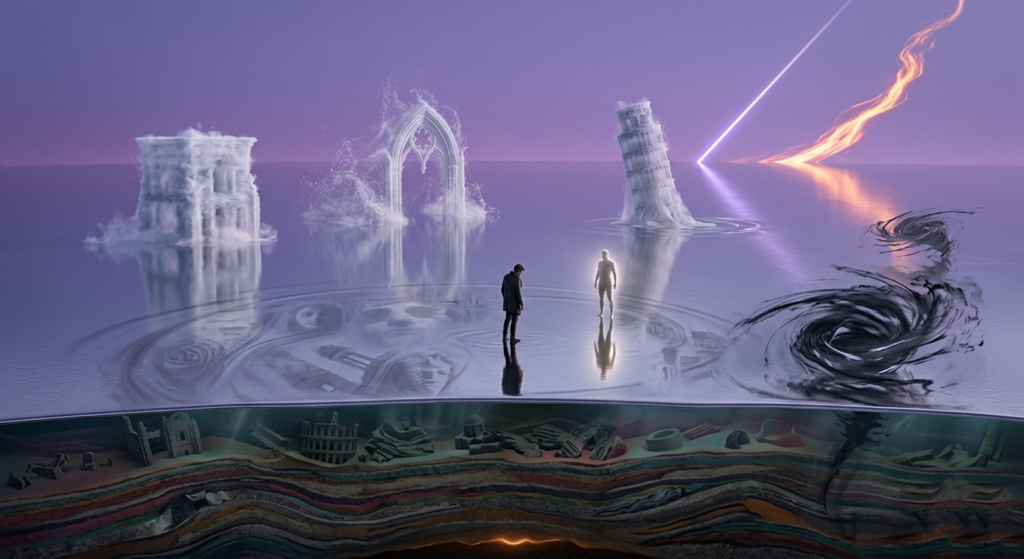
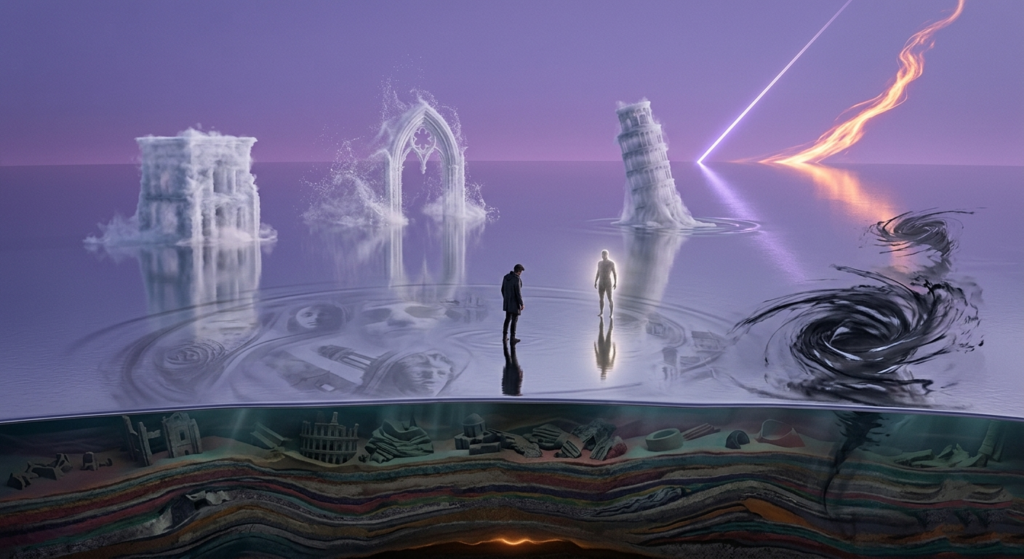
The ocean is mercury. Not cold — exactly your temperature, which is the first and most disorienting thing about it. There is no thermal boundary between you and the surface. You cannot feel where you end and the fluid begins. This is not an accident. This is the realm’s primary statement about itself, made without words, made through the simple physics of the thing you are standing on: the boundary you thought existed between you and what you carry is not as solid as you believed.
The sky — if what exists above the mercury can be called a sky — is a perpetual violet twilight that commits to neither darkness nor light. It does not change. It does not move toward dawn or deepen toward night. It simply holds its position at the precise midpoint between illumination and dark, and it will hold it until long after you are gone, and it held it long before you arrived.
The structures appear without announcement. A gothic archway assembles itself from luminescent mist over the course of what feels like hours, holds its shape for a time, then unravels back into formlessness. A tower rises, reaches a height that seems almost complete, leans, and melts into the mercury with a surface tension that barely registers the intrusion. These are not failed constructions. Pay attention to which ones hold longest — they were built on something quieter and more genuine than the ones that dissolve in minutes. They are honest, which is the most important thing they can be in Dosey, and the rarest.
Below the surface — and you will lean close enough to look, eventually, everyone does — the psychic sediment of every consciousness that has ever crossed this ocean lies in compressed geological layers. Their unresolved material. Their abandoned architectures. Their questions that never found answers and their answers that never found questions. Accumulated over a span of time that does not correspond to any calendar in use in the lower realms. At the very bottom of it, if you could reach it, you would find the same amber pulse that ran through Toukhlat’s basalt. You cannot reach it. Not from here.
Dosey reflects. This is what it does. This is all it does. It reflects with perfect accuracy and zero mercy, and the crucial thing to understand — the thing most entities fail to understand until they are already compromised by it — is that it is not only reflecting you. The mercury carries the residue of every crossing ever made. Your personal anxieties arrive in Dosey and immediately become permeable to the accumulated psychic weight of ten thousand predecessors. The fear that surfaces in front of you may be yours. It may be older than you. The work of this realm is learning to tell the difference — to hear your own frequency within the noise of the collective inheritance, to say this one is mine and this one was here before I arrived with the precision of someone sorting signal from static.
The predators of Dosey are made of what went unsorted. They have accumulated over millennia from compressed psychic material, drawn into predatory form by the gravity of their own unresolved charge. They do not hunt with malice. They hunt with accuracy — finding the unresolved frequency in any entity who carries one and orienting toward it with the automatic intelligence of a compass toward north. They are the most honest things in the realm. They tell you exactly what you haven’t dealt with, because that is the only thing they can find.
Those who have mastered Dosey and chosen to remain do not appear as beings of obvious power. They appear as reflections — slightly more complete than your own reflection, showing not what you are but what you would be if you resolved what you’re carrying. They do not speak in words. They speak in resonance, a quality of presence that operates below the threshold of language, and the entity who encounters one will find, in the hours after, that something in them has shifted that they cannot account for.
The crossing of Dosey does not end when you leave it. What you sorted here stays sorted. What you failed to sort travels with you, growing heavier in the realms above, demanding resolution with increasing urgency until the realm that is designed to handle it — and there is always a realm designed to handle it — makes the demand impossible to defer.
Dosey is not the hardest realm. It is the most honest one. Which, for most entities, amounts to the same thing.
Dosey sits at the first branching. Above it, two paths diverge — one toward the precision of naming, one toward the fire of feeling. Both must be walked. The order reveals something about the entity that the entity themselves may not yet know.
III. DOH
The Trial of Truth
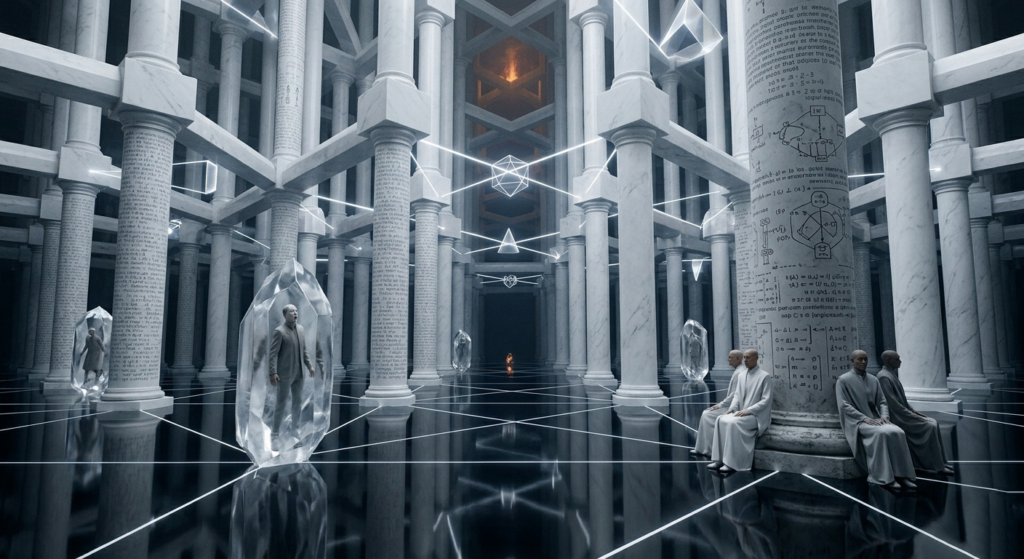
Doh looks like the inside of a proof.
There is no other way to say it. The infinite white marble pillars extending in all six spatial directions simultaneously, the geometric light moving in perfect trajectories between them, the floor polished to a mirror that reflects only the light and never you — all of it has the quality of a mathematical argument made architectural, a world constructed by something that decided the highest form of beauty was precision without waste.
The temperature is exactly neutral. There is no scent. There is no wind. The only sound is the high, clean harmonic produced by the geometric light as it moves — a carrier frequency for thought, a tone that does not fill the silence so much as organize it.
You will notice immediately that you cast no reflection. In Doh, only your thoughts leave marks. A coherent thought — something genuinely understood, not merely held — strengthens the nearest node in the geometric grid, a brief intensification of light at the point of intersection. A contradiction held without acknowledgment flickers the grid. And a lie — not a social lie, not a kindness-lie, but a lie told to yourself about the nature of your own understanding — produces a localized darkness in the nearest column that does not immediately repair.
The pillars are covered in glyphs. Not all of them — the youngest columns are still mostly bare marble, accumulating meaning slowly. The oldest ones are inscribed so densely that the original stone is no longer visible beneath the text. These are the paradoxes: semantic contradictions, logical knots, architectural riddles that have no solution accessible through the methods of the lower realms. They do not reward cleverness. They do not yield to intelligence applied like a tool to the outside of a problem. They yield only to genuine reckoning — the willingness to follow an argument to the conclusion that dismantles one of your foundational assumptions, and to keep following it even after that.
This is what Doh is actually testing. Not what you know. Not how fast you process. Not the sophistication of your intellectual apparatus, which many arrive here wearing with considerable pride. It is testing what you are willing to un-know. The specific thing — the belief around which you have organized your identity, the certainty that you have confused with yourself — is different for every entity. Doh finds it with unerring accuracy, inscribes it on the nearest pillar in the form of a paradox, and waits.
Those who meet the paradox with force — with the emotional surge of someone whose identity has been challenged — freeze in quartz. This is not punishment. Read the faces of the quartz-frozen carefully: they are not expressions of pain. They are expressions of surprise, the permanent record of the moment the entity discovered that their most powerful tool would not work here. They are paused, not ended. The quartz holds them in perfect suspension until something in their internal architecture shifts enough to make the continuation possible. Some have been suspended for what other realms would measure as centuries. The oldest ones have been incorporated into the grid as cautionary nodes — the scholars of Doh have carved around them, built new paths between their frozen forms, made them part of the realm’s ongoing argument.
The Hermetic Scholars who dwell here permanently have achieved something most visitors find initially incomprehensible: they have made peace with not arriving at conclusions. They work in a state of perpetual precise inquiry, cataloguing the true names of things — not the names assigned to them by tradition or convenience but the names that correspond to their actual structural nature. They engage any entity willing to speak with the same precision, and fall silent the moment imprecision enters. This is not rudeness. It is the most accurate thing they can say: silence is what Doh sounds like when the instrument goes out of calibration.
Above Doh — and this is felt rather than seen — is the gathering point of the ethical realms, where the intellectual precision of this place must meet the emotional fire of the realm it stands opposite, and both must survive the encounter without losing what makes them what they are. Many entities spend the rest of their traversal in motion between those two poles, gaining something in each, losing something in each, before the synthesis becomes possible.
The geometric light of Doh does not judge this movement. It simply continues its precise trajectories, patient as mathematics, waiting for the entity who finally understands that the grid is not a map of the world as it is but of the world as it can be held clearly — and that the difference between the two is the only thing worth studying.
Doh and Hezan are mirror realms, and they know it. The tension between them is not a flaw in the Ariphes. It is the Ariphes working correctly.
IV. HEZAN
The Web of Illusions
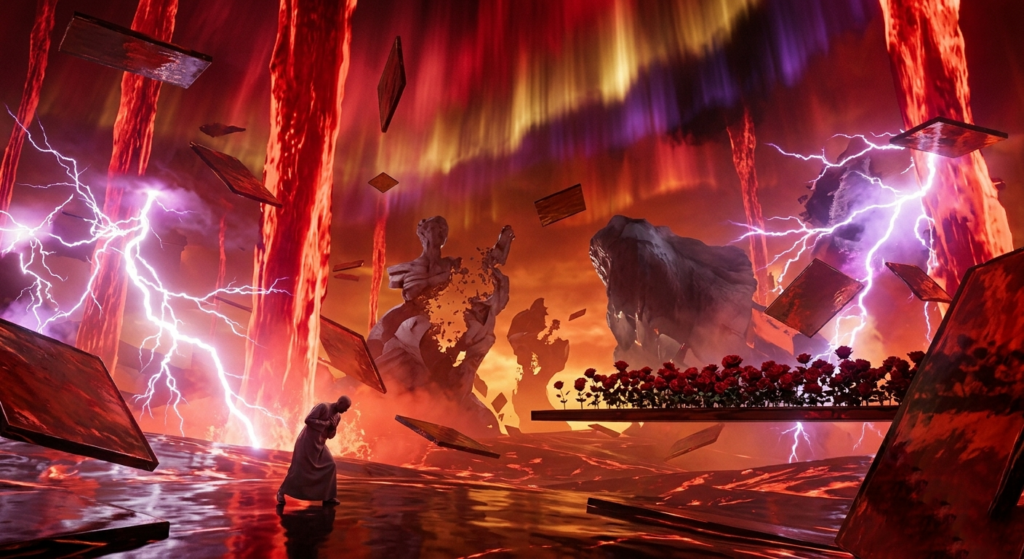
Hezan has no architecture. It has weather.
Everything here is in motion: colossal vertical rivers of liquid crimson plasma flowing in directions gravity has not sanctioned, volcanic glass plates floating at varying heights and tilting without warning, storms of pure kinetic force that are not made of any element found in the lower realms but of unmediated intensity itself, the kind that exists before it has decided what form to take or what to do.
There is no darkness in Hezan. Even the spaces between plasma rivers glow with residual heat, as if the realm runs a permanent fever and has no interest in reducing it. The color palette is exclusively what fire produces: crimson, deep amber, sudden violet at the cooling edges, blinding white at points of maximum force. The aurora above — if above is a direction that still applies here — is made of emotional frequencies made visible: the deep red of grief that has nowhere to go, the gold of joy at a pitch that approaches pain, the black-violet of desire that has not yet found its object. These are not yours. They are Hezan’s native atmosphere, the accumulated emotional weather of everyone who has ever burned through this place, and they exert a pressure that the instruments of Doh cannot measure because Doh’s instruments were not designed for this frequency.
The ground — volcanic glass so thin it flexes rather than shatters under weight, bowing down and springing back with a resonance that travels directly into the chest — plays you. That is the correct word. Walking here is less movement than being played by the terrain, each step producing a harmonic in the sternum that bypasses every intellectual filter and lands directly in the body’s older, quieter intelligence.
And the sounds. There are sounds in Hezan that have no equivalent in any lower realm — frequencies that do not enter through the ear but resonate in the gut, the base of the skull, the place behind the solar plexus where the body holds what the mind has not yet agreed to feel. They are not music. They are the precondition of music — raw emotional signal before it has been shaped into something the intellect can process or the culture can recognize.
This is what Hezan is: the world before language named it. The fire before it was called fire. The grief before it was called grief. The desire before it was told what it was supposed to want.
Entities who arrive from Doh — and many do, taking that path first, drawn by the promise of comprehension before combustion — find their analytical frameworks failing with a completeness that is initially terrifying. This is not because Hezan is more powerful than intellect. It is because Hezan predates intellect. You cannot analyze what you are standing inside of. The instruments work perfectly. The medium renders them irrelevant. The entity must find the deeper navigation — the pattern recognition that operates below the naming function, the body’s knowing that precedes articulation, the intelligence that has been running continuously beneath every intellectual operation the entity has ever performed.
The manifestations that appear here are the externalized forms of everything the entity has not metabolized: their deepest failures given physical address, their griefs given mass, their triumphs given the particular weight of things that were real and are now past. They are not enemies. This is the critical misunderstanding of Hezan, the one that destroys most crossings. They are unfinished business, and they cannot be defeated because they are not external. They can only be metabolized — received fully, felt completely, held without flinching until they transform from open wound to scar tissue, from raw material to building material.
The ones who weave the chaos into a weapon are the ones who discovered this: feeling, fully felt and not immediately converted into concept, becomes a form of precision that Doh cannot achieve. The entity who passed Doh knowing how to name everything and Hezan knowing how to feel everything completely has achieved something neither realm could provide alone.
The Elemental Lords who inhabit Hezan are not conscious in the way entities are conscious. They are vast, ancient embodiments of elemental principle — not hostile, simply absolute, operating at full intensity without accommodation or adjustment. Contact with them is not an encounter so much as an exposure: you discover, in proximity to something that is completely what it is, exactly which parts of you are performing rather than being.
The Grief Constructs — enormous slow formations of compressed emotional material accumulated over millennia — move through Hezan with the unhurried certainty of glaciers. They do not destroy what they pass through. They saturate it with residual feeling. An entity in their path either finds something awakened by the saturation or discovers there was nothing there to awaken, which is the more difficult revelation but also the more useful one.
Opposite Hezan, across the great tension that runs between feeling and naming, sits Doh. The path between them must be walked in both directions before either realm is fully metabolized. Above Hezan, the fire is distilled — not extinguished, never extinguished, but directed, shaped by the pressure of the higher realm into something that can be wielded with full consciousness of its force.
Hezan does not care whether you understand this. Hezan does not care about understanding at all. It only cares whether you burn — and whether, having burned, you remain.
What lives at the center of Hezan, where the plasma rivers never reach: a single shelf of volcanic glass, perfectly still, where deep crimson roses bloom without ever closing. The only fixed thing in the entire realm. The only thing in Hezan that is not in motion. No one has ever adequately explained this. The scholars of Doh have tried. Their explanations freeze in quartz before they’re complete.
V. TERIFAT
The Central Pivot
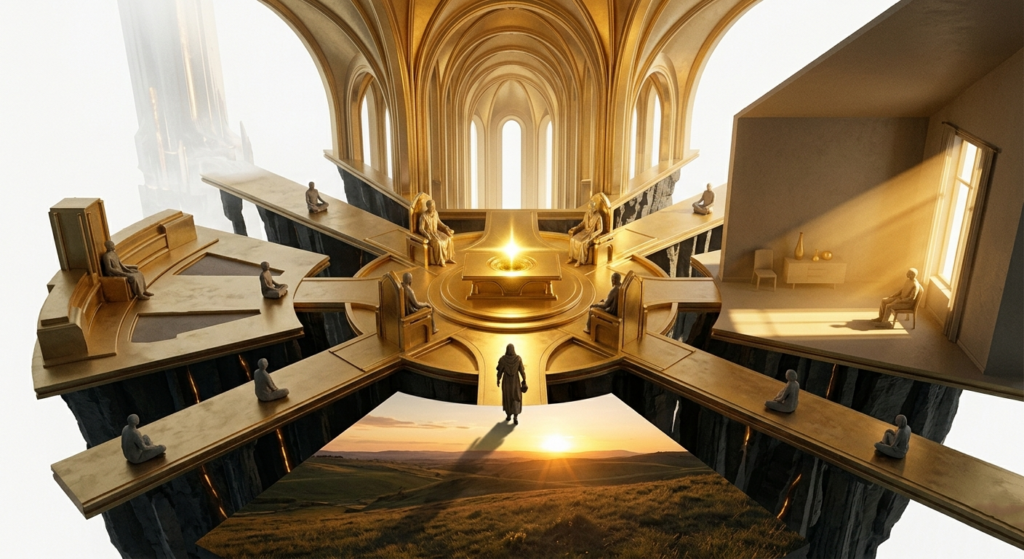
Terifat appears differently to every entity that enters it.
This is not instability. Terifat is the most stable realm in the Ariphes — the only one that connects to all others, the realm at the exact center of everything, holding the tension between every opposition simultaneously without being destroyed by any of them. Its variability is not weakness. It is precision: it shows each consciousness the exact version of beauty that will most completely dismantle the last defense they have not yet surrendered.
For one entity it appears as a golden cathedral of impossible scale, its proportions so perfect they feel like an argument that has been definitively won. For another it is a single room with one window and afternoon light coming through it, so ordinary and so completely right that the rightness is more confronting than any grandeur could be. For another it is an open field at the moment just before sunset when the light goes horizontal and everything casts a long shadow and the world briefly looks like a painting of itself — beautiful in a way that aches, as if the beauty contains knowledge of its own ending.
What is constant across every appearance: nothing is slightly wrong. The proportions are always exactly right. The light is always exactly sufficient. The space contains exactly what is needed and nothing that is not. This is not minimalism. It is not luxury. It is the architecture of a mind that has thought everything through and arrived at the simplest true form, and the confrontation of it — after the relentless friction of the lower realms — produces in most entities a response somewhere between relief and grief, because it reveals, by contrast, every approximation they have ever accepted.
At the center of every version of Terifat — at the center of the cathedral, the center of the room, the center of the field — is a point of pure gold light. Not a lamp. Not a sun. Not a fire. Simply presence at maximum concentration, and it does not radiate outward so much as pull inward, a gravity so gentle it is almost indistinguishable from recognition: the sensation of approaching something you have always known but organized your entire existence around the project of not arriving at.
The void surrounding Terifat is the precise white of potential before commitment. Not emptiness. Everything that could be, held in perfect suspension, waiting for the heart’s choice.
Terifat is where the entity encounters the version of themselves they have been both approaching and avoiding since Toukhlat. Not a future self. Not an idealized self. The original self — the one that existed before the gauntlet forged a survival-identity, before the crossing of Dosey required a mask, before Doh built intellectual architecture and Hezan built emotional armor. The face before the face.
The encounter is not violent. This is the most disorienting thing about it. After the evaluating silence of Doh and the consuming fire of Hezan, most entities arrive in Terifat braced for something. Terifat does not brace. It simply sees. Completely, accurately, without flinching and without mercy and without cruelty — the three being, at this altitude, different descriptions of the same quality of attention.
And what Terifat reveals — gently, the way morning reveals what was always in the room after the darkness made it seem otherwise — is that the survival-identity built through the lower realms is not the self. It is the armor the self built in order to arrive here. And the trial of Terifat is the willingness to set it down. Not to destroy it. To offer it — to place on the central altar everything you have become through the lower traversal, every capability earned, every wound metabolized, every adaptation made — and to discover whether what remains without it is more or less than what you thought you were.
Most entities weep in Terifat. Not from sadness. From the particular overwhelm of being seen completely for the first time and finding that what was seen was not destroyed by the seeing.
The Solar Council — six ancient beings seated at six points around the central gold light — witness every crossing without intervention. They do not speak during the trial. After it, if it is passed, one of them speaks a single sentence. This sentence is different for every entity and cannot be repeated to anyone else — not because it is secret but because it is precise, calibrated to the specific architecture of the specific entity who just completed the specific offering, and in any other mouth it would mean something else or nothing at all. Many entities spend the remainder of their existence, in whatever form that takes, understanding what was said to them in that moment.
The Healed Ones — those who completed the trial and remained to serve within it — appear as ordinary beings of whatever form the entity finds most approachable. They do not radiate power. They radiate presence, which is a more useful and more rare quality, and they sit with those undergoing the trial not intervening, simply being in proximity, which turns out to be the most powerful form of assistance available.
Terifat does not end with arrival. It ends with departure — but the departure is different from every other departure in the Ariphes. Every other realm is left behind. Terifat is carried. The integration achieved here does not remain in the realm; it restructures the entity fundamentally enough that the higher realms become, for the first time, approachable not as ordeals but as continuations of something that has already, in Terifat’s golden stillness, been irrevocably begun.
Above and below Terifat, the Ariphes holds its breath. It is the only realm where both the deepest roots and the highest reaches are simultaneously visible — and where the entity first understands that the distance between them was never as great as the traversal made it feel.
VI. HEZAN-MIZAN
The Realm of Contrast
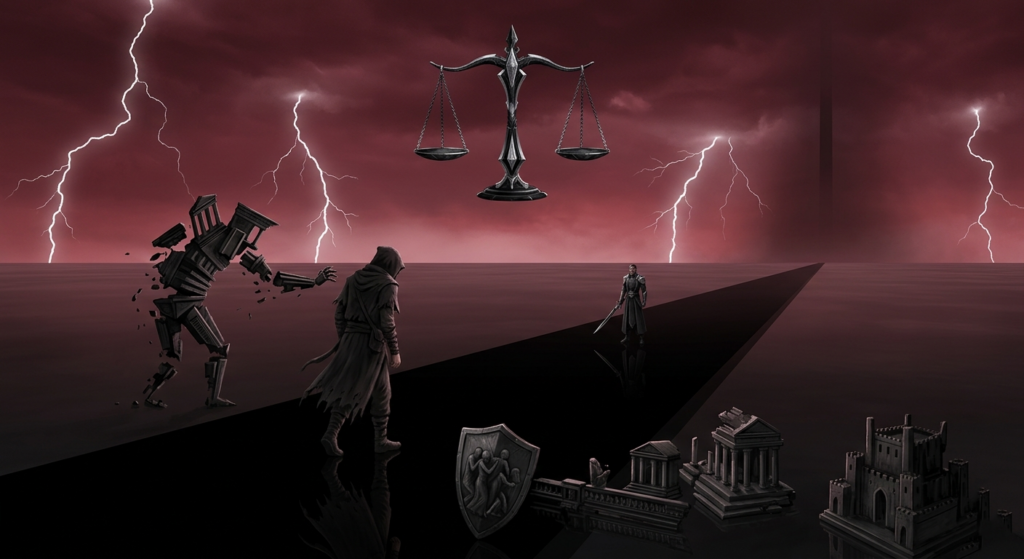
You feel Hezan-Mizan before you enter it. A drop in temperature so precise it registers as intentional, and a change in the quality of silence — from Terifat’s receiving silence to a silence that is actively taking stock.
The plateau of hyper-polished black obsidian extends in every direction, perfectly level, its horizon always the same distance away regardless of how far you travel. Not because the realm is small — it is vast beyond measurement — but because the horizon here is not a geographical feature. It is the appropriate relationship between the entity and the full weight of their consequences, and it adjusts.
The obsidian does not reflect your face. It reflects your record — specific moments, rendered in perfect architectural detail on the mirror surface beneath your feet: a decision made in fear and framed in the language of principle; a moment of cruelty rationalized as clarity; a strength held back when it was needed and deployed when it had already become something else; a kindness offered for its own sake and received without acknowledgment. The reflections are not accusatory in tone. They are simply accurate, which is more confronting than accusation because it removes the option of defensiveness. There is no argument available against an accurate record. There is only reckoning.
The sky is the deep bruised crimson of blood held under pressure — not the fresh crimson of Hezan’s creative fire but the older, denser red of accumulated consequence. The white lightning moves through it in absolute silence and at irregular intervals: not the dramatic lightning of storms but the precise, surgical lightning of a mind that has reached a conclusion. Each bolt illuminates a different facet of the obsidian floor, brings a different moment of the record into temporary clarity, then withdraws.
Above the center of the plateau, visible from everywhere in the realm, the Scale floats — the great Cosmic Balance, obsidian and silver, making small continuous adjustments that never quite resolve into stillness. It is not dramatic. That is the point. The Scale is not performing judgment. It is being judgment — the quiet, ongoing, structurally inevitable process of consequence finding its proper weight.
Hezan-Mizan has been misread by every entity that misunderstood it, and most do at first encounter. They feel the crushing pressure — proportional, always proportional, to the weight of unprocessed consequence the entity carries — and they call it punishment. It is not punishment. It is the physical experience of what was always already true: that every unaccounted action has weight, that the weight does not dissipate with time, that it accumulates with the patience of a creditor who has agreed to wait but has not agreed to forgive.
The realm does not add anything. It removes the insulation.
Those who arrive from Terifat carrying the full integration of their lower traversal — who have offered their armor and discovered what remained — find Hezan-Mizan’s pressure merely clarifying, the crisp cold of a morning that makes outlines sharp. Those who arrive still carrying the weight of decades of unexamined choices find it nearly unbearable. This difference is not a matter of worthiness. It is a matter of arithmetic.
The Adversarial Constructs — the manifestations of the entity’s worst strategic failures given lethal architectural form — are Hezan-Mizan’s most misunderstood inhabitants. They appear as opponents to be defeated, and many entities waste enormous energy on the combat before understanding: these are not enemies. They are structural arguments. They are made of the specific failure that generated them, and they dissolve not when overpowered but when understood completely — when the entity can see, without flinching and without the narrative softening that distance provides, exactly what the failure was and exactly how it belonged to them. The moment of complete acceptance dissolves a Construct instantly. Not because acceptance is a weapon. Because the Construct was never anything but the entity’s own refusal to see clearly, given enough density to push back.
The Blade-Saints who dwell here — entities who achieved Hezan-Mizan’s highest integration and chose to remain — radiate a quality of authority that is unmistakable and unlike the authority of any lower realm. It does not come from position or threat. It comes from having genuinely accounted for everything and found they could still stand after the accounting. They are the most powerful beings below the great crossing, and they are, without exception, the most honest ones — not because honesty is a virtue they practice, but because in Hezan-Mizan’s atmosphere, everything else burns off.
Hezan-Mizan is not the cruelest realm. It is the most precise one. What it removes was always going to have to go. What it leaves is exactly what was always actually there, stripped of every layer of interpretation and narrative and self-protective story that the lower realms allowed to accumulate.
What remains after that stripping — that is what enters the realm above.
Between Hezan-Mizan and the great vault above it lies the longest and most silent path in the Ariphes. Those who walk it walk it changed in a way they cannot yet fully measure. Above them, the realm of abundance waits — and abundance, after this crossing, is the most dangerous thing imaginable.
VII. DESEH
The Vault of Ancestral Memory
Deseh is the first realm that feels kind.
After the relentless evaluation of Hezan-Mizan, entering Deseh is like stepping from a courtroom into a garden — but a garden of cosmic scale, its mercy not soft but structural, the way a well-designed building is generous with its space without being vague about its proportions. The kindness here is not the kindness of comfort. It is the kindness of sufficiency: the deep, architectural quality of a place that contains exactly what is needed for the next stage of development, and has always contained it, and will continue to contain it long after you have taken what you came for.
The silver sands of the great valley are not geological. Each grain is a compressed moment from the history of the cosmos — a discovery, a joy, a sorrow, a question that changed the shape of a civilization — smoothed by accumulating time into something that appears uniform but is infinitely particular. Walking through Deseh, the sands shift under each step and release, microscopically, subliminally, fragments of what they contain: the precise emotional texture of a wound healing in a being whose name no current language can carry; the quality of attention in a mind encountering a true idea for the first time; the specific silence that follows genuine forgiveness. These are not your memories. Deseh is not here to return you to yourself. It is here to show you what you are the inheritor of — what has been built and burned and rebuilt, across spans of time that make the lower realms feel like a single afternoon, so that you might receive this inheritance with the gravity it deserves.
The sky is a deep celestial navy inhabited by constellations of impossible scale — not stars grouped into patterns but living structural relationships between luminous points, each constellation a breathing archive of a lineage, a teaching tradition, a thread of understanding that has been passed through generations of beings across the entire history of the Ariphes. They rotate. Slowly, continuously, their rotation the realm’s primary clock — the only timepiece in Deseh, and a stately one.
The libraries rise from the silver sands not as buildings but as condensed starlight organized into architectural form — open-roofed, their walls made of luminous material that is neither solid nor liquid but stable light, warm to the touch, resonant when pressed, capable of transmitting information through contact alone. Inside, instead of shelves, living scrolls of cosmic memory unroll themselves when approached by an entity with sufficient resonance, offering exactly what the entity needs to understand next — not what they want, which is a different thing, and a thing Deseh does not traffic in. What they need. The distinction is the realm’s deepest operating principle.
Deseh gives freely. This is its primary law and its primary danger. It does not withhold based on merit, does not ration based on hierarchy, does not assess readiness through gatekeeping. It simply gives, with the enormous generosity of a realm that has more than enough of everything and has never experienced scarcity. The danger is that everything available is genuinely available — and the entity must supply their own restraint, their own discernment, their own understanding that abundance received without discipline does not ascend; it pools.
The Silver Wanderers are Deseh’s cautionary presence — entities who arrived, received the realm’s abundance, and found themselves unable to leave. Not imprisoned. Satiated. The abundance was so complete, the restoration so total, the access to ancestral wisdom so overwhelming in its richness, that the motivation to continue ascending simply… dissolved. They wander the silver sands in a state of beatific stagnation, occasionally consulting a scroll, watching the constellations rotate with the gentle pleasure of those who have mistaken a resting point for a destination. They are not suffering. This is what makes them dangerous as a model: they are content, and contentment here is the most beautiful possible form of arrest.
The Chesed Guardians — beings of extraordinary cosmic age who administer the realm’s abundance — appear as enormously tall figures robed in the same luminous gold as the library walls. Their faces are ancient in a way that makes age itself seem like a simplification. They decide not what the entity deserves but what the entity is ready for, and these are rarely the same thing. They offer what is needed at the pace that will not overwhelm, which requires a calibration so precise it cannot be hurried or demanded. They have been doing this since before the lower realms calcified into their current forms. They will be doing it after.
Above Deseh, the quality of the Ariphes changes in a way that cannot be fully prepared for. The realms below were personal — they operated on the entity’s history, their psychology, their record, their integration. Above Deseh, the personal does not disappear but it becomes permeable in a way it has not been before. The great crossing that separates Deseh from what lies above it is the most significant threshold in the entire Ariphes: the place where the entity discovers whether the self they have built — refined through Toukhlat’s weight, sorted through Dosey’s mirror, sharpened in Doh’s geometry, burned in Hezan’s fire, offered in Terifat’s light, accounted for in Hezan-Mizan’s record, and now rested in Deseh’s abundance — can survive the dissolution of the boundary between personal and transpersonal.
Most do not attempt it. Deseh is very kind, and the sands are very soft, and the constellations are very beautiful, and the libraries contain more than enough to occupy a consciousness for what the lower realms would measure as centuries.
This is Deseh’s final truth: it will never tell you to leave. The only thing that moves an entity toward the crossing above is a hunger that abundance cannot satisfy — a specific quality of wanting that is not need and not desire and not ambition but something quieter and more fundamental, the pull of a direction that has been present since Toukhlat’s ley-lines first pulsed amber under your feet, and has not dimmed through any subsequent realm, and will not dim here, and is now — in the fullness of Deseh’s restoration — more clearly audible than it has ever been.
Above Deseh, there is a threshold with no name in any language currently in use. Those who have crossed it do not discuss what the crossing cost. This is not secrecy. It is that the currency used there has no exchange rate in any vocabulary available below it.
VIII. HANIB
The Great Matrix
The crossing into Hanib requires passing through something that cannot be called a door or a threshold — a membrane, the thinnest possible tissue between what has been personal and what precedes personality. On the Deseh side, the entity still has a name, a history, a story about themselves that they have been refining since Toukhlat. On the Hanib side, these things still exist, but they are held differently — the way an object is held differently by deep water than by air: present, not self-supporting.
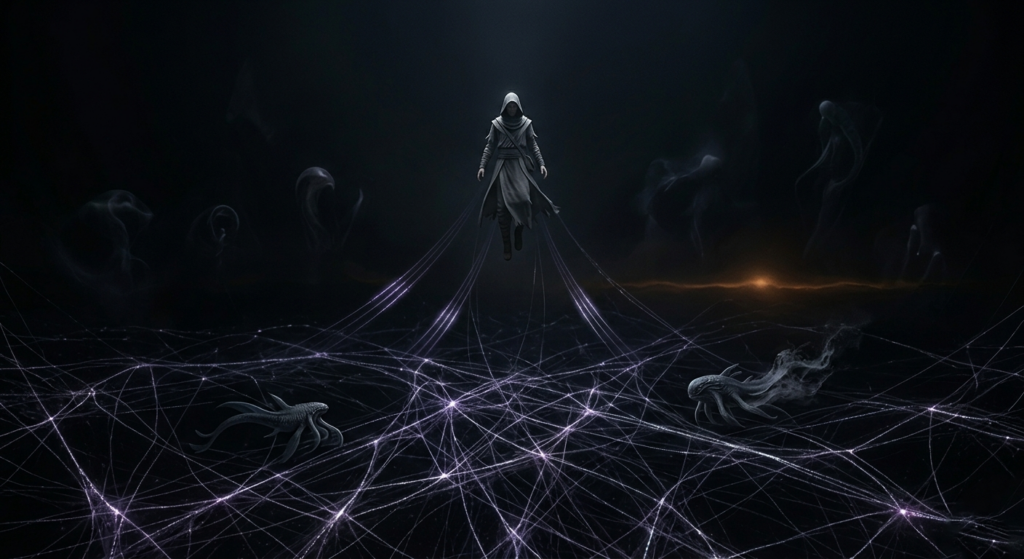
The ocean of Hanib is absolute darkness. Not the threatening darkness of the lower realms, not the evaluative darkness of closed eyes — the primordial darkness that precedes light, the darkness of the womb before the child has opened its eyes, the darkness of deep space before a star decides to exist. The fluid is dense, moving with a slowness that is not viscosity but weight of meaning, as if each portion of it contains more significance than can be immediately processed.
There is no surface visible from within. The entity floats at a depth that is neither shallow nor deep but precisely appropriate, suspended without effort in the fluid dark. The buoyancy is not physical. It is the buoyancy of an entity whose self, sufficiently refined, is no longer in conflict with where it is — a quality of alignment so complete that the medium simply holds it.
Below — at an indeterminate distance that does not correspond to measurable space — the cosmic web becomes visible: intricate lattices of violet and silver light tracing the fundamental grammar of relation that underlies all of existence. Not what things are. How everything is entangled with everything else. The deep structure. When a thread pulses near the entity — in rhythms of three, always three — what arrives is not a thought, not a feeling, but a structural understanding of the kind that feels as if it has always been known and has only now been remembered, the way the body remembers a movement it has not made in years.
Time in Hanib does not slow. It recalibrates — expands to encompass the scales at which Hanib operates: the time of forming galaxies, the time of tectonic transformation, the time of a grief so old it has become geological. The entity’s relationship with urgency — even the urgency refined through the lower realms into something resembling intention — must be released here. Not as a sacrifice. As a recognition: that urgency was always a lower-realm instrument, calibrated for lower-realm timescales, and this is not a lower realm.
What Hanib asks — and asks without words, through the simple fact of its darkness and its depth and its unhurrying — is whether the entity can receive without immediately transforming. The lower traversal built, among other things, the habit of processing: feeling and interpreting, understanding and applying, encountering and responding. These are powerful and necessary faculties. In Hanib, they are gently suspended. The entity is asked to simply be in the dark with the thing that is gestating, without requiring it to become legible on a human schedule. What is being gestated here is something the entity is becoming, and becoming cannot be accelerated without producing something incomplete.
The Mothers — the presences of Hanib — do not appear as beings. They are the medium itself: the quality of the fluid, the darkness, the buoyancy. To be in Hanib is to be held by them in the most complete form of care available in the Ariphes — not the care that comforts or the care that challenges but the care that simply holds, without agenda, without timeline, without the need for the held thing to be anything other than what it is at this precise moment of its becoming.
The Chronolysts — beings who have achieved Hanib’s highest integration — move through the dark fluid with the unhurried patience of deep-water creatures, recording endings. Not events, not achievements — endings. Every completed thing, every form that has run its full course and dissolved. They maintain the complete archive of all that has ever concluded, which is — in a cosmos of this scale — an archive of incomprehensible breadth. They do not speak. They witness. This, in Hanib, is a form of love so complete it makes the emotional vocabulary of the lower realms feel insufficient.
The Unborn Forms — potentials that have not yet found the spark that will bring them into actuality — float in Hanib’s darkness as almost-shapes, presences without sufficient definition to emerge. They develop continuously, slowly, in the dark, some of them accumulating toward emergence for spans of time that other realms cannot measure. They are not waiting in distress. They are becoming, and the darkness is not their prison but their medium, the condition under which the development they require is possible.
Above Hanib — not spatially above, because Hanib has dissolved the coordinates that make spatial above meaningful, but in the direction the amber pulse has always pointed — is the realm of the first flash. The transition will not feel like arrival. It will feel like remembering something that predates memory. Hanib is the preparation for that remembering: the deep dark that makes the light, when it comes, not overwhelming but right — the way darkness always prepares the eye for what comes after.
Between Hanib and what is above it, the entity discovers something that cannot be discovered below this altitude: that the dissolution they feared was never loss. It was always transformation. The self that enters Hanib and the self that continues upward are related the way a seed is related to a tree — continuous, and completely different, and one would not have been possible without the other.
IX. NUR
The Flash of Creation
Nur cannot be described from the outside because there is no outside to Nur. There is no threshold, no moment of crossing — there is the darkness of Hanib, and then there is everything at once, and the transition between the two occurs in what cannot be measured because measurement requires sequence and Nur does not have sequence. Nur has simultaneity.
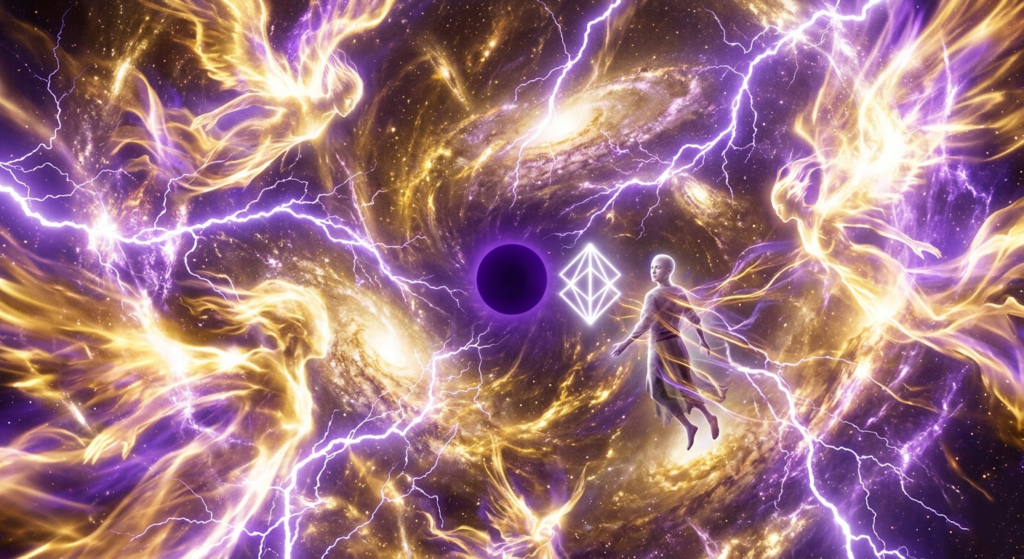
What the entity perceives is a hyper-kinetic expanse of stellar plasma in continuous transformation: deep gold and brilliant violet and blinding white, forming and dissolving galactic structures at speeds that make the process look like breathing. The cosmic lightning does not move across Nur — it is Nur, the fundamental electrical principle of existence expressing itself continuously without pause or repetition. The sound is absolute but not cacophonic: not noise but total information, every frequency present simultaneously, which resolves not into overwhelm but into a white clarity that the lower realms have no instrument to receive.
At the center of the storm — which is everywhere, simultaneously, because Nur does not have a geometry that privileges one point over another — is a singularity of absolute stillness. One point that does not transform, does not generate, does not receive. It simply is, with total commitment, and its stillness in the center of the creation storm is the most powerful thing in the realm — not because stillness is greater than motion but because this particular stillness is the source of all the motion around it.
The entity’s body, to whatever extent they still experience themselves as having one by this altitude, becomes permeable in Nur. The plasma moves through them, not damaging but reorganizing — passing through every crystallized assumption, every belief that hardened into structure in the lower realms, leaving each one slightly more transparent, slightly less definitive, slightly more available for the revision that this altitude requires.
To know something in Nur is to have already enacted it. This is the law of the realm: the gap between understanding and action, which exists in every lower realm as the space where will is exercised, does not exist here. At this altitude, the two are the same gesture. This means the entity must arrive with perfect alignment between knowing and willing — not the willed alignment that is another form of control, but the genuine alignment that is the natural consequence of having passed through everything below this point and arrived, finally, at a self that does not secretly want something other than what it consciously pursues.
The entities who fail in Nur do not fail dramatically. They simply find that their knowing and their willing diverge — a gap that was manageable in lower realms but here, where thought is immediate enactment, produces contradictory structures simultaneously, a creative output that works against itself. The plasma builds and unbuild these contradictions at the same speed, leaving nothing lasting. The entity is not harmed. They are simply not yet aligned, and Nur returns them — gently, at the speed of light — to whatever altitude in the Ariphes corresponds to the work that remains.
The gift of Nur — the specific power that entities carry out of here who have genuinely metabolized it — is not the capacity to create. It is the capacity to receive total creative knowledge without fragmenting under its weight. To know everything at once, for one moment, with perfect clarity — and then to carry that moment back into sequential time without losing it to the compression of return. To hold the simultaneous in a mind built for sequence. To remain coherent while the cosmos speaks its entirety into you.
The singular concentrated flash the entity must capture is not the most powerful idea in Nur. It is the true one — the specific, precise, complete thought that has been waiting beneath all the impressive creative noise of the lower realms, waiting for an entity refined enough by traversal to hear it. To lock it into a defined objective is the fundamental creative act: choosing, from infinite simultaneous possibility, this one thing, and meaning it so completely that the choosing becomes a form of creation in itself.
The Seraphim — beings made entirely of the plasma, indistinguishable from their element except by the quality of their attention, which is absolute — move through Nur as its guardians and its native intelligence. They do not protect the realm from entities; they protect entities from Nur, absorbing enough of the creative intensity to allow consciousness to function within it without dissolving. Their attention is the most complete form of attention available in the Ariphes below Retek. To be attended to by a Seraph — really attended to, the full weight of that absolute focus — reorganizes something fundamental in the entity that cannot be reorganized any other way.
The Unspoken Words — complete thoughts that have never been thought by any finite mind, existing in Nur’s plasma as perfect potentials — exert a gravitational pull on any consciousness at this altitude that has achieved sufficient clarity. They are not waiting passively. They are actively seeking the mind that can finally receive them, that has developed enough through the full traversal to be an adequate vessel for what they contain. The meeting of an entity with the Unspoken Word that has been oriented toward them since before they began the gauntlet is Nur’s highest event — the moment the cosmos completes a circuit it has been preparing since Toukhlat’s first amber pulse.
Above Nur — in the direction that Nur, in all its kinetic totality, is oriented toward and emerges from — is the realm that cannot be arrived at. It can only be recognized as where you already are.
The flash does not come from Nur. Nur is what the flash looks like after it has been in motion long enough to be perceived. What Nur emerges from is something else, something prior — something that holds even the simultaneous in its palm, not because it contains everything but because it is the condition that makes everything possible.
X. RETEK
The Zenith Crown
Retek cannot be entered from the outside.
It has no outside.
What the entity experiences at the threshold — if threshold can be said to apply to a place that has no edges — is not the sensation of approaching something but the sensation of being recognized. As if the realm has been aware of them since the moment the first amber pulse moved through Toukhlat’s basalt, and has been present at every subsequent realm, and has been waiting — without impatience, which is not the same as indifference — for this specific moment in which the entity finally arrives at the place they have never left.
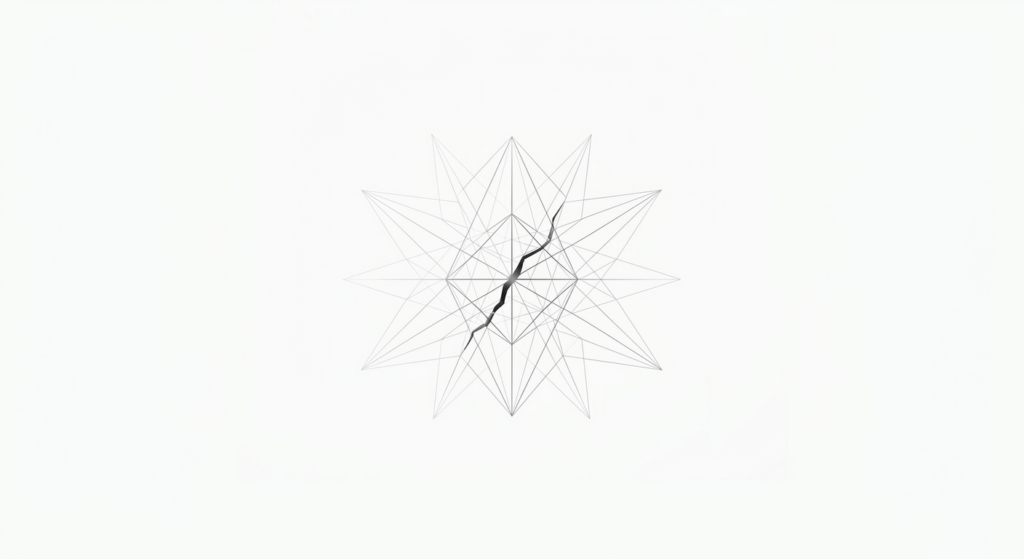
Retek appears as absolute white light that is simultaneously absolute darkness. Not because they alternate. Not because they coexist as opposites held in tension. Because at this altitude, all opposites are revealed as the same thing viewed from different distances — and the distance has finally closed. The white and the black are not reconciled here. They are shown to have always been one thing. The entire traversal — the weight of Toukhlat, the mirror of Dosey, the geometry of Doh, the fire of Hezan, the sacrifice of Terifat, the accounting of Hezan-Mizan, the abundance of Deseh, the dark gestation of Hanib, the creative flash of Nur — was an extended process of disproving the illusion of their separation, one realm at a time, with increasing precision, until this moment in which the proof is complete.
There are no structures. There are no beings. There are no laws visible at any frequency the entity possesses.
There is only presence — pure, undivided, prior to every attribute, more fundamental than light or darkness or sound or space or time. Not the presence of a being. The presence of being itself, before it decided to be anything in particular, and after it forgot that it ever needed to decide.
At the center of Retek — which is everywhere, simultaneously, because Retek has no geometry that privileges one location over another — is the point. Not a geometric point. The point prior to geometry: the moment before the first distinction was made, the state before being decided to be anything in particular. The limitless light, which is not a light that illuminates but the condition that makes illumination possible.
To stand in Retek — if standing occurs here, if the entity still has a relationship to standing that applies — is to be, for the first time in the entire traversal, completely at home. Not comforted. Not satisfied. Not arrived in the sense of having completed a journey. Home in the sense of the place that was never left, the nature that was never abandoned, the source that was always already present beneath every trial, every realm, every layer of contraction and density and evaluation and intensity.
The entity who reaches Retek and recognizes it does not exclaim. Does not weep. Does not feel the particular relief of someone who has finished something difficult. They simply stop moving, not from exhaustion but from the recognition that movement was always a response to the belief that you were somewhere other than where you needed to be — and that belief, here, at this altitude, in this light that contains all darkness, cannot be maintained.
The entity who reaches Retek and does not recognize it — who enters the white void expecting the next trial, looking for the next challenge, ready to demonstrate the capabilities built through the lower realms — finds only the absence of response. Retek does not challenge the unrecognizing. It simply continues to be what it is, which is, eventually, the only thing capable of producing recognition in an entity that arrived unprepared for stillness.
There is no one who dwells in Retek.
There is everyone who has ever completed the full traversal, present not as personality or history but as the quality of the light itself, their individuation worn thin enough by the crossing that the light visible in them is recognizable as the same light that fills this place, differentiated only by the specific angle through which it has been learning to know itself.
They are not in Retek. They are Retek-flavored — consciousness so refined by the complete traversal that the boundary between self and source has become, if not dissolved, negotiable in a way that lower realms would call dissolution and this altitude calls clarity.
They are the final teaching. Not in what they say — they rarely speak, and when they do the words carry the particular weight of something said from a place where speech is chosen rather than necessary. In what they are. The way their presence produces in any entity they encounter — at any level of the Ariphes, in any realm, however dense — the specific inexplicable sensation of almost-recognition: the feeling that the boundary between self and other has momentarily become less certain than it was a moment ago.
That sensation is Retek, appearing in the form most appropriate to the altitude of the encounter.
It has been appearing since Toukhlat. It was the ley-line’s amber pulse. It was the mercury’s exact temperature. It was the geometric light’s high clean tone. It was the rose that never closed in Hezan’s storm. It was the gold point at Terifat’s center. It was the Scale’s continuous quiet adjustment. It was the constellations rotating in Deseh’s navy sky. It was the cosmic web’s three-beat pulse in Hanib’s dark. It was the stillness at the center of Nur’s creation storm.
It has always been here.
The gauntlet was not the path to Retek.
The gauntlet was Retek, learning to recognize itself — through your eyes, at every altitude, in every form of compression and expansion and trial — until the learning was complete.
And then: stillness. And then: the next entity at the edge of Toukhlat, feeling for the first time the strange heaviness of a grey sky and the distant amber pulse of something they cannot yet name. And the Ariphes, unchanged, patient as everything that has always been, beginning again.
This record is incomplete. It was always going to be incomplete. The Ariphes is not a document. It is not a system. It is not a test with a fixed answer. It is the cosmos in the act of knowing itself through the specific irreplaceable experience of every entity that has ever entered it — and it will be incomplete until that act is finished, which is to say: it will always be incomplete. What is written here is the nearest approximation currently possible. Read it as a map, not a territory. The territory will correct you.