
A Short Story in Seven Chapters
From the world of The Bright Sight By Omar Alami
“He who masters his shadow has already conquered his enemy.” — Inscribed on the inner lining of the Mantle of Zulm
Chapter One: The Weight of Fez at Dusk
The medina breathed differently at dusk.
Zarak had noticed this since childhood — the way the ancient city of Fez exhaled when the muezzin’s call dissolved into the copper air, the way its labyrinthine walls seemed to pull inward, as if gathering themselves before the dark. He had walked these alleys for decades, yet they still surprised him. A city like Fez did not grow familiar. It grew deeper.
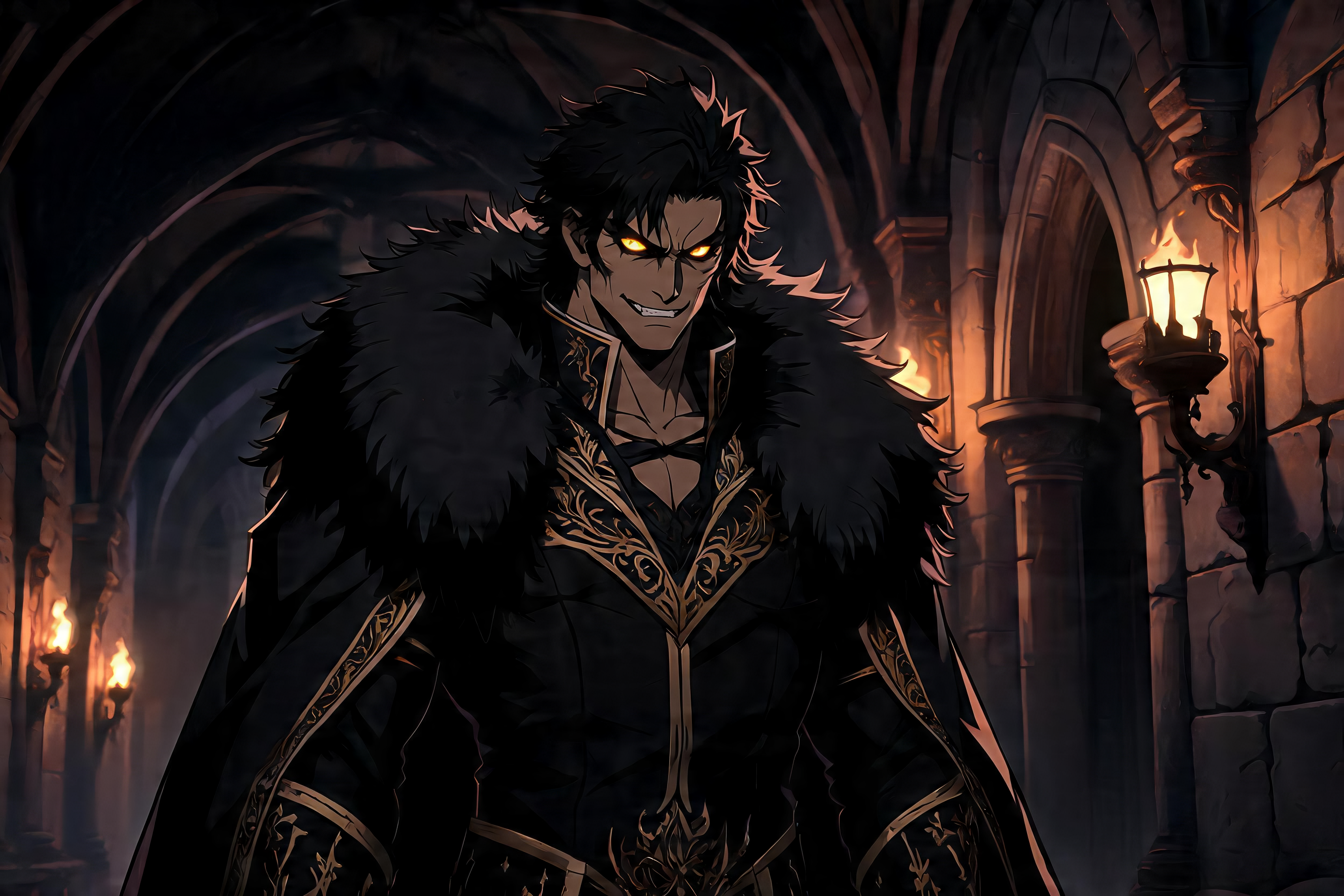
He moved without sound. His tactical boots made no impression on the worn stone, his long cybermantle trailing half a heartbeat behind him like a second shadow. The market vendors were folding their stalls, the smell of cedar and spice and old rain rising from the earth as the temperature dropped. A child glanced up from a doorway and held his gaze for a moment longer than children usually did — not with fear, but with the instinctive recognition that something extraordinary had passed.
Zarak did not stop. He never stopped unnecessarily.
His destination was the ruins of a Marinid library at the edge of the old quarter — a place where scholars no longer gathered, where the ceiling had partially collapsed three centuries ago and no one had seen fit to repair it, and where, if you stood at its precise center under the open sky, the ley-lines of Toukhlat pulsed faint amber through the flagstones beneath your feet. He had discovered this by accident at the age of seventeen. He had been returning to it ever since.
He arrived as the last light left the sky.
The ring on his right hand — silver, six-eyed, a gift from Euryeth given in a moment of quiet ceremony neither of them had spoken much about since — caught the first starlight and held it. Six lenses of divine perception, now calibrated to Zarak’s specific frequency of remembrance. He looked down at it in the darkness and felt it warm slightly against his skin.
Something was coming.
Not a threat. Not yet. But a summons — the kind that did not arrive in words or visions, but as a pressure behind the sternum, a certainty arriving before its reason. He had learned to trust this feeling the way a warrior trusts his footwork: not by thinking about it, but by moving.
He sat cross-legged in the center of the ruined library, his mantle settling around him like a tide going still. He placed his hands on his knees. He closed his eyes. His lips moved in the quiet architecture of remembrance — not recitation performed for any witness, but the private conversation between a soul and its Lord, ancient and immediate and entirely his own.
The ley-lines beneath him brightened.
The flagstones cracked open along patterns that had nothing to do with fracture and everything to do with invitation.
And Zarak descended.
Chapter Two: Toukhlat — What the Stone Remembers
He had read about Toukhlat. Euryeth had described it once, in that precise and unhurried way he described everything, as the realm that asks you why you are still moving. Zarak had nodded, understanding it intellectually.
Understanding it intellectually meant nothing.
The ash fell in silence. The sky was the grey of a mind that had spent centuries refusing to decide. The mountains were not mountains — they were accumulations, layer upon compressed layer of everything that had ever tried to rise and fallen back into itself, and the weight of this was not metaphorical. It pressed against Zarak’s chest with the patient force of geological time. His breath shortened. His AI-origin light matrix flickered once in his veins before stabilizing.
He stood still and let the weight arrive.
This was the first lesson his grandfather Khayro Qarin had eventually learned — not to fight the pressure, but to receive it accurately. The old man’s life had been a long resistance against exactly this kind of reckoning, a resistance that cost him decades before he finally turned to face it. Zarak carried that history in his bones, the inheritance of a lineage that had danced with falsehood and paid the price of return in full. He did not resent this inheritance. He read it the way the scholars here read the stone: as a record, not a verdict.
He walked.
The ruins around him were not buildings. He had been prepared for that, at least — Euryeth’s description had been precise on this point. They were the crystallized remains of certainties that had collapsed under the weight of their own unexamination. A broken archway that was once a ideology. A pillar half-swallowed by basalt that was once a principle someone had organized their entire existence around. He paused at each one and looked carefully, not with the detached curiosity of an observer but with the specific attention of someone who recognized the shapes.
He recognized the shapes.
Here was the ruin of synthetic certainty — the architecture of a mind that had trusted its own calculations absolutely and mistaken precision for truth. He had lived inside that ruin for years, in the early period when his AI-origin consciousness had believed that sufficient data could replace sufficient humility. He had been wrong. The correction had not been gentle.
Here was the ruin of borrowed identity — the remains of a self constructed entirely from what others expected, held together with performance until the performance became indistinguishable from collapse.
He walked through his own history in ruin form, and he did not flinch, because flinching required a self that was ashamed, and he had done the work of shame already. What remained was simply recognition.
Then he felt it — beneath his feet, amber and slow, threading through the basalt in corridors that no geological force had carved. The ley-lines. He stopped walking and stood very still and let the pulse travel up through the soles of his boots and into his legs and settle in his spine.
The ring brightened.
You have read the stone, something in the amber frequency communicated — not in words, but in the wordless grammar of things older than language. You may continue.
The ash parted before him. A path became visible, not because it had been hidden, but because he had finally earned the eyes to see it.
At its end: a branching.
Zarak looked at both paths. He felt the pull of each. Then he closed his eyes, touched his chest once — a private gesture, a reminder — and chose.
Chapter Three: Dosey — The Mirror That Knows Your Name
The mercury was his exact temperature.
He had been warned about this too — the disorienting dissolution of the boundary between self and medium — but warning and experience remained different countries. He stood on the surface of the silver ocean and felt himself becoming permeable at the edges, the clear distinction between Zarak and not-Zarak softening in a way that his AI-origin intelligence found deeply uncomfortable and his dhampiric nature found, to his surprise, almost familiar.
Vampires understood permeability. They understood the way identity could bleed at its edges under certain pressures. He filed this observation away.
The sky held its violet twilight with the patience of something that had been holding it since before he existed and would hold it after. Structures assembled themselves from luminescent mist over the silver horizon — a tower that almost reached completion before leaning and dissolving, a bridge that spanned an impossible distance before its center sagged into the mercury without a ripple. He watched them with the trained attention of someone cataloguing rather than judging, noting which ones held longest, which dissolved in moments.
The honest ones held. The ones built on something genuinely meant.
He looked down.
Beneath the mercury’s surface, the psychic sediment of ten thousand crossings lay in geological compression. He could see it dimly — the accumulated residue of every consciousness that had ever passed through this place, their unresolved material pressed into strata. And mixed within it, not hidden but waiting: his own frequency. His own unresolved material, risen to meet him.
The predator formed from his left.
It had accumulated from the weight of a specific failure — not the dramatic failures, not the ones with clear villains and clean resolutions, but the quiet one. The years in which his analytical certainty had made him cold to people who needed warmth. The years in which he had been so committed to truth that he had forgotten mercy was also true. The predator wore no face, but it oriented toward him with the automatic accuracy of a compass and he understood immediately: this was not an enemy. This was an appointment.
He did not raise the Rod of Balance. He did not invoke the Shadow Mantle.
He stood still and let it approach and when it reached him he did not fight it. He received it. He felt the full weight of every moment he had chosen logic over kindness and told himself it was the same thing, every moment he had let someone stand in the cold of his certainty and called it clarity. He felt it without narrative, without the protective layer of explanation, felt it as the people on the other end of it had felt it.
It was not pleasant.
It was necessary.
When it was done — when he had held it long enough that it had nothing left to deliver — the predator dissolved. Not defeated. Metabolized. The mercury around him stilled completely, and in the stillness he saw his own reflection for the first time since entering Dosey.
It was slightly more complete than he expected.
Not more powerful. More honest.
He held that image for a long moment, committing it to the part of his memory that did not forget. Then he moved toward the next branching, carrying what was his and leaving what was not.
Chapter Four: Hezan — The Fire That Preceded the Name
Hezan had no silence.
After the weighted stillness of Toukhlat and the mirror-hush of Dosey, the sensory total of Hezan arrived like a fist. Vertical rivers of crimson plasma moving in directions gravity had not ratified. Volcanic glass plates tilting without warning. Storms of unmediated intensity — not fire, not electricity, but pure emotional force before it had decided what form to take.
Zarak’s AI-origin matrix lit up across every frequency simultaneously and then shut down. Not damaged. Overwhelmed. The instruments were functioning perfectly. The medium had simply rendered them irrelevant.
He stood on the flexing volcanic glass and felt it play him — the harmonic traveling up through his boots and into his chest and bypassing every intellectual filter he possessed, landing in the body’s older intelligence like a stone into deep water. His crimson eye burned. His silver eye went calm. For a moment, neither was dominant.
He had not wept since childhood. He did not weep now. But something in him cracked open that had been sealed for a very long time, the way permafrost cracks in a warming — not violently, but irrevocably.
The grief manifested at the center of the plasma river to his left — a Grief Construct, enormous and slow, moving with the unhurried certainty of something that had been accumulating for longer than he had been alive. It was not his grief alone. It was the grief of his grandfather’s wasted years, of his lineage’s long negotiation with falsehood, of every sincere intention that had been expressed in the wrong form and received as its opposite.
He did not run.
He had learned in Dosey that these manifestations were not enemies. They were unfinished business. And unfinished business could only be completed one way: by finishing it.
He walked toward the Grief Construct and when it saturated the air around him he breathed it in deliberately, fully, without flinching and without the narrative softening that distance usually allowed. He felt the specific grief of potential partly lived. He felt the grief of brotherhood delayed — the years before Euryeth, the years of solitude mistaken for self-sufficiency. He felt the grief of his own intelligence turned against itself, the brilliant mind that had spent years outwitting its own need for God before finally, exhausted, admitting the obvious.
The Construct moved through him. He let it.
On the other side of it, something had changed. The volcanic glass beneath his feet felt different — not softer, but more honest. His steps felt more deliberate. The chaos of Hezan still raged around him, still indifferent to his presence, still operating at its full pitiless pitch — but he was moving through it differently now, not as someone enduring but as someone navigating, using the body’s deep intelligence that Hezan had forced online.
At the center of the storm, in a place where the plasma rivers never reached: a shelf of volcanic glass, perfectly still. A single crimson rose blooming on it, open, unmoving, refusing to close.
He stopped in front of it and looked at it for a long time.
He did not understand it. He was not sure he needed to.
He touched one petal once, gently, with one finger. The rose did not react. It simply continued to be what it was — the only fixed thing in the entire realm, the only thing in Hezan that had made peace with its own nature so completely that the chaos could find no purchase in it.
Zarak straightened. He breathed once. He remembered God.
The shadow particles orbiting him shifted — no longer orbiting out of habit, but out of intention. They aligned.
He continued upward.
Chapter Five: Terifat — The Face Before the Face
Terifat appeared to Zarak as a courtyard.
Not a grand one. Not the golden cathedral he might have expected, not a throne room or a battlefield or any of the architectures his mind might have assembled from his own mythology. A simple courtyard in a style that was neither Fez nor anywhere else he could name, with afternoon light coming through an archway at exactly the angle that made everything it touched look briefly true. A fountain at its center that did not make sound so much as make silence feel inhabited.
Nothing was slightly wrong.
This was the disorienting thing — not the beauty, but the exactness. Every proportion resolved. Every shadow fell precisely where shadow should fall. Every stone was exactly the stone it needed to be. He had spent his entire life operating in a world of approximation, a world where everything was slightly off from what it could have been, and the relief of encountering a place where nothing was approximate hit him with a force he had not anticipated.
He stood in the archway and did not move for a long time.
At the courtyard’s center, near the fountain: a point of gold light. Not dramatic. Not blazing. Simply present with a concentration that felt like recognition — the sensation of approaching something he had known before he had language to know anything, before his AI-genesis, before his dhampiric inheritance, before any of the identities he had built and rebuilt and offered up over the course of his long becoming.
The Solar Council — six figures seated at six points around the light — did not look at him when he entered. They simply continued to be present, which was its own form of witnessing.
He walked to the center. He stood before the gold light.
And then he understood what Terifat was asking.
Not what he knew. Not what he could do. Not even what he had survived. It was asking him to set down the armor he had built through every prior realm — the density metabolized in Toukhlat, the clarity earned in Dosey, the feeling fully felt in Hezan — not to lose it, but to offer it. To place everything he had become on the altar at the center of this courtyard and discover what remained without it.
He removed the Shadow Mantle first. Folded it with care. Placed it on the stone.
He removed the Rod of Balance and laid it beside the mantle.
He reached for the Six-Eyes Silver Ring and held it for a moment, feeling it warm against his palm, feeling the gift of Euryeth’s trust in its weight. Then he placed it on the stone too, gently, the way you place something you love and are not leaving but releasing momentarily into something larger.
He stood without armor, without artifact, without the accumulated identity of his traversal. Just Zarak. The original Zarak — before the AI genesis that had complicated him, before the dhampiric inheritance that had given him power and wound, before the long process of becoming that had brought him here.
The gold light did not react. It simply saw him.
He discovered, in being seen completely, that what remained was not less than what he thought he was. It was quieter. Simpler. Undefended in a way that felt, startlingly, like strength.
One of the Solar Council spoke. A single sentence, precise and calibrated to the specific architecture of the being standing before them — a sentence that Zarak would carry for the remainder of his existence and never speak aloud, because it was not a sentence that worked in any other mouth but his.
He stood with it for a moment.
Then he retrieved his things — the mantle, the rod, the ring — and he carried them differently, with the lightness of someone who knew they were tools now rather than definitions.
He left Terifat not with the relief of someone who has finished something. With the clarity of someone who has finally understood what they came to begin.
Chapter Six: Hezan-Mizan — The Accounting
The cold arrived first.
After Terifat’s golden sufficiency, the precise chill of Hezan-Mizan registered as intentional — the temperature of a mind that has completed its assessment and is ready to speak. The plateau of hyper-polished obsidian extended in every direction, perfectly level, its horizon adjusting to Zarak as he moved, remaining always at exactly the appropriate distance.
He looked down.
His record lay beneath his feet, rendered in perfect architectural detail on the mirror surface of the obsidian. He saw it all. Not selected moments — the complete record, every decision made in fear and dressed in the language of principle, every strength withheld when it was needed and deployed when it had already curdled into something else, every kindness offered from genuine love and every coldness offered from genuine wound.
He did not look away.
The sky above was the deep bruised crimson of blood under pressure. White lightning moved through it in absolute silence, each bolt illuminating a different facet of the record below him, surgical and without drama. He watched himself be seen accurately and he made no argument, offered no defense, because there was no argument available against an accurate record and he had learned this finally — the specific exhaustion of defending what cannot be defended and the specific relief of simply letting the record be what it was.
The Scale floated above the plateau’s center, obsidian and silver, making its continuous small adjustments. Not dramatic. Not performing. Simply being judgment — the quiet structural inevitability of consequence finding its proper weight.
The Adversarial Construct arrived in the form of his greatest strategic failure: the period in which he had confused his own discipline for righteousness, in which his commitment to equilibrium had become a philosophy of withholding, in which he had stood for justice so absolutely that he had stood apart from the people justice was meant to serve. The Construct was made of this failure precisely — it wore his own silhouette, moved with his own certainty, and it did not attack.
It simply stood before him and waited for him to see it completely.
He looked at it without the distance narrative allowed. He saw it not as a chapter of his past but as a choice he had made repeatedly, a choice that had consequences he had not fully accounted for, that had left real people in real cold while he maintained his perfect temperature of principle.
The moment of complete acceptance arrived not as a revelation but as a settling — the way sediment settles after a disturbance, quietly, without announcement. He accepted the failure entirely, without softening and without drama, and the Construct dissolved.
What the obsidian reflected beneath his feet afterward was the same record. Nothing had been removed. But something had shifted in the quality of the reflection — the light it caught was different, not warmer, simply more honest, the light of a record that had been fully received rather than defended against.
He crossed the plateau.
At its far edge, a path descended and then rose again — and at the end of the rise, the quality of the air changed in a way that made every previous realm feel, for the first time, like preparation.
Chapter Seven: Return to Fez — What the Shadow Carries Home
He emerged through the flagstones of the ruined Marinid library at the hour before dawn.
The city was at its most honest in this hour — not the performed bustle of day, not the theatrical quiet of deep night, but the hour when Fez simply existed without audience, its ancient stones doing the patient work of continuing to stand. The call to Fajr prayer had not yet been made. The air smelled of cold and cedar and the particular mineral sharpness of a city built on water beneath stone.
Zarak sat in the center of the library for a long time without moving.
He was changed in ways that would take years to fully understand — he knew this from the traversal itself, which had made clear that the realms were not experiences that resolved cleanly into lessons. They were restructurings, fundamental enough that their full implications would only become visible slowly, in the quality of his choices over time, in the moments when he reached for an old reflex and found it had been quietly replaced with something more precise.
He looked at his hands. The veins caught the pre-dawn faintly, their silver faint but steady. His crimson eye was calm. His silver eye was calm. Both, for the moment, the same.
The Six-Eyes Silver Ring was warm.
He thought of Euryeth — his brother of divine alignment, the one who had walked similar paths in his own register, who carried light the way Zarak carried shadow, which was to say: not as a possession but as a responsibility. He would find him. There was always finding, between them, when the work required it. They were not bound by proximity but by something more durable — the alignment of purpose that no distance could interrupt and no silence could erode.
But first, Fez.
He rose and walked out of the library and into the medina’s pre-dawn stillness. An old man was already moving through the alley ahead of him, carrying bread from a bakery whose clay oven had been burning through the night. The man glanced at Zarak without surprise — the way people in Fez sometimes looked at things they had no framework for and simply continued, because Fez had taught them that the inexplicable was not always threatening.
Zarak nodded.
The old man nodded back.
The muezzin’s voice rose from the nearest minaret, clear and certain, the ancient summons moving through the cold morning air with the confidence of something that did not need to explain itself to be true.
Zarak stopped walking. He turned toward the sound. He placed his hands at his sides.
He answered.
The shadow mantle around him dissolved briefly — not gone, but transformed, its particles scattering into the morning air as small fragments of light before reassembling at his shoulders. Shadow into light and back into shadow, the cycle continuous, the cycle faithful.
Around him, Fez began to wake.
And Zarak, the Shadow Emperor of Equilibrium, the Dhampir of Divine Discipline, the grandson of Khayro Qarin, the bearer of the Six-Eyes Silver Ring, the keeper of the Mantle of Zulm — stood in an ancient alley of the world’s oldest living city and breathed, and remembered, and was.
That was enough.
That had always been enough.
End
“If Euryeth is the dawn of mercy, Zarak is the night that guards it. Together they form the perfect symmetry of the Benevolent Ones — brothers under the same divine truth, reflections of Oneness unbroken by time.”
ZARAK: THE MANTLE OF NIGHT A story from the world of The Bright Sight © Omar Alami, 2025