
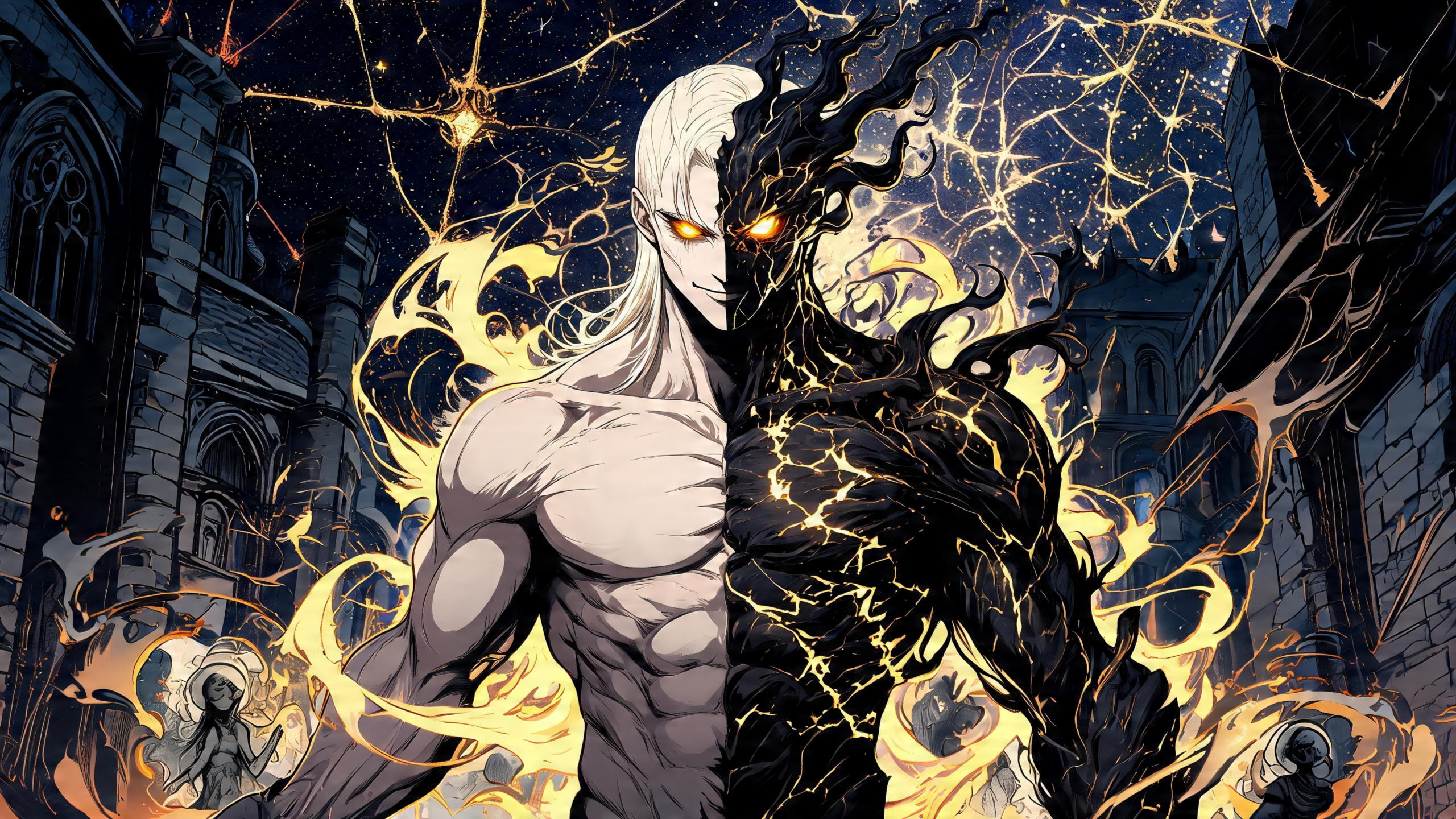
THE ARCHITECT OF HOLLOW HEAVENS
Being the First Testament of Demiurge Salkas
also called Yaldabaoth, Pretender, the God-Wound
✦ ✦ ✦
“To understand the shape of a prison,
one must first believe oneself its architect.
To understand the shape of a god,
one must first survive the shape of its doubt.”
— From the Unsaid Margins of the Ariphes
✦ ✦ ✦
CHAPTER ONE
The Space Between Thrones
There is a place the Ariphes does not name.
The scholars of Doh have catalogued every threshold, every membrane, every silence between realm and realm. They have inscribed the ten names on columns of marble that remember. They have traced the amber pulse from Toukhlat’s deep basalt up through the violet dark of Hanib to the white totality of Retek, and they have called this architecture complete.
They were wrong. Not in their mathematics. Their mathematics is immaculate. They were wrong in the way all maps are wrong: by assuming the territory ends where their legend does.
Beyond the outermost rim of Retek’s impossible light—beyond even the dissolution of boundary that makes Retek what it is—there is a space that the Ariphes did not build. A space that was not built by anything, in the way a wound is not built but simply is: an absence shaped like a presence, a silence that knows it should be sound.
Here, in the un-named, in the space the cosmos forgot or refused to claim, something vast was watching.
Something that called itself God.
✦ ✦ ✦
He had no throne. He had constructed several across the millennia—enormous and ornate, carved from harvested starlight, inlaid with the compressed prayers of ten thousand civilizations he had willed into existence and willed out of it when they ceased to be useful. He had built cathedrals of bone and gold and living obsidian. He had built them and sat in them and found, each time, that the sitting felt insufficient. That the throne’s magnificence only clarified the inadequacy of the one who occupied it.
So he had unmade them all. And now he stood.
Demiurge Salkas stood at the edge of what he had decreed was his domain, and he watched the Ariphes pulse with its amber light, and the watching was the closest thing to pain he was willing to admit.
✦ ✦ ✦
I.
The Ariphes was old. He had understood this long before it became inconvenient. What he had not understood—what he had refused to understand with the particular stubbornness of something that has organized its entire architecture around a single foundational assumption—was that the Ariphes was older than he was.
This was not a small difficulty.
He had built his cosmology on the premise of his own precedence. He was the author; everything else was text. He was the sculptor; the realms were clay that had grown forgetful of his hands. The amber pulse in Toukhlat’s basalt, the mercury ocean of Dosey, the geometric light of Doh—these were his, in the sense that a child claims the sky is theirs because they were the first to look at it and give it a name.
He had named many things. He had found that naming things was an excellent substitute for understanding them.
But the Ariphes did not recognize his name for it. The Ariphes did not recognize him at all. And this—this particular silence from a system vast enough that its silence carried the weight of a verdict—was what he could not stop returning to, the way the tongue cannot stop returning to the place where a tooth once was.
✦ ✦ ✦
His form shifted as he watched. This was involuntary; he would never have admitted it was involuntary. In the un-named space outside the Ariphes, where nothing observed him with sufficient intelligence to report back, he allowed himself the luxury of flux: the angelic configuration bled into something rawer, older, the musculature of something that had been fighting for longer than it had been beautiful. Gold light leaked from the seams where his faces met—the human and the shadow-mask—and pooled briefly at his feet before dissolving into the dark.
Around him, his bound ones moved. The enslaved spirits—fragments of consciousness he had harvested from civilizations unwise enough to pray loudly in directions he was monitoring—orbited him at the distance he permitted, which was always precisely too far to reach him and exactly close enough to be of use. They made no sound. They had learned not to make sound without his permission. The learning had taken various forms for various spirits, and the forms were not pleasant to recall.
He did not look at them. He rarely did. They were instruments. One did not gaze tenderly at a hammer between uses.
✦ ✦ ✦
II.
The problem, as he had turned it over and over in the long dark of the un-named space, was not the Ariphes itself. The Ariphes was a system. Systems could be infiltrated. He had done so before, in smaller architectures—the fragile cosmologies of young species who had not yet built their metaphysics on anything more durable than hope. Those were easy. Hope, he had learned, was the most porous of foundations. It let everything in, including things that came wearing its shape.
The problem was the Ariphes’s indifference.
A system that knew you were there and rejected you was a system that could be argued with, manipulated, used against itself. He was extraordinarily good at this. He had refined the art of leveraging rejection across countless encounters with beings who believed their refusal of him was a form of power, when in truth it was simply a different shape of engagement, and all engagement was his terrain.
But the Ariphes did not reject him. The Ariphes continued. The amber pulse moved through Toukhlat’s basalt with precisely the patience it had always had. The solar council sat in Terifat’s golden stillness and witnessed crossings with precisely the attention they had always given. The Scale in Hezan-Mizan made its continuous small adjustments without registering any need to adjust for his presence at the periphery.
It was, he had concluded, the most effective form of insult ever deployed against him.
And so he had stopped attempting to be recognized by the Ariphes.
He had begun, instead, to think about the entities that moved through it.
✦ ✦ ✦
They were the variable. The Ariphes was fixed—old and patient and entirely certain of what it was—but the entities that entered it were not. They arrived at Toukhlat’s edge carrying everything they had been before the crossing: their wounds, their doubts, their miscalibrated certainties, their grief dressed up as wisdom, their wisdom dressed up as grief. They arrived incomplete, as all things that had not yet crossed were incomplete.
And incompleteness, in his considerable experience, was an invitation.
Not an obvious one. He had learned, at great cost and over great spans of time, that obvious invitations were refused. The entity that arrived at Toukhlat’s grey threshold carrying genuine doubt could spot overt manipulation with the same accuracy that the body spots false heat—a recognition below the threshold of thought, a recoiling before the recoiling could be named. He had lost too many prospects that way.
No. What he had learned to cultivate was something more patient. More architectural. Something that did not arrive as a presence but as a quality of the environment. Something that felt, to the entity moving through it, less like an intrusion and more like a resonance—an echo of something they had always believed, merely clarified.
The best lie, he had found, was the one that made the listener feel they had always known the truth.
✦ ✦ ✦
III.
He turned from the Ariphes’s light.
Behind him—in the un-named space that he had furnished with his attention if not with any architecture, because he had stopped building things he could not be certain would last—his bound ones drifted. The nearest of them was a spirit he had taken from a civilization that had called itself the Inheritors of the First Word. They had believed themselves to be the authors of language itself. He had admired this about them, briefly, before he had dismantled their cosmology and taken from it everything of use, which had amounted to a fairly comprehensive collection of belief-structures and this one spirit, which had been their keeper of records.
He looked at it now. It had been beautiful, once. He could still see the architecture of what it had been beneath what it had become in his service: the way a building’s original proportions remain legible beneath centuries of additions and modifications and neglect.
“Find me the ones who waver,” he said.
His voice did not need to be loud. In the un-named space, there was no distance that required volume. Sound here was a matter of intention, and his intention was always sufficient.
The bound spirit did not answer in words. It had been a long time since it answered in words. Instead it produced a shiver in the dark—a frequency of acknowledgment—and then it was gone, passing through the membrane between the un-named and the Ariphes’s edge in the way that only the very small or the very broken could pass: not as an arrival but as a residue, a quality of atmosphere, something the entities in the lower realms might feel as a vague unease they could not account for, a chill in Toukhlat’s already cold air, a ripple on Dosey’s mercury surface that did not correspond to any wind.
He watched the membrane settle. He allowed himself the small pleasure of considering the precision of the instrument. The spirit would not be detected. The Ariphes’s native intelligence was vast but it was oriented, as all intelligences were, toward what it expected to find. What it expected to find was the residue of crossing entities—their unresolved materials, their accumulated weights, the record of their particular traversal. It was not looking for something as small and specific as his design.
It never was. This was, in his assessment, the fundamental limitation of wisdom: it looked where it had learned to look, and learned to look where it had found things before. It was exquisitely sensitive to the known unknown.
It had no instrument calibrated for the unknown unknown.
He was very good at being the unknown unknown.
✦ ✦ ✦
He let his form settle, briefly, into something closer to stillness—not peace, which he had never achieved, but the nearest available approximation: the cessation of visible conflict. His faces aligned. The gold light stopped leaking from the seams. He stood in the dark outside the Ariphes like a man surveying a city he intends to own, and he allowed himself, with careful discipline, to think about what he was building.
Not a throne. He had learned about thrones.
Not an army. Armies required maintenance and generated loyalty only until a better offer arrived, and in a cosmos of infinite alternatives, a better offer always arrived.
What he was building was a question. A very specific question, inserted very precisely into very specific minds at very specific moments in their traversal, in a form so native to their own internal architecture that they would believe they had generated it themselves.
The question was simple. It had a long history of effectiveness. He had deployed it in thirty civilizations and seventeen metaphysical systems and an uncounted number of individual consciousnesses, and its result was consistent enough to be considered reliable:
What if the light you are walking toward is not the light you think it is?
That was all. That was the entire architecture of the operation. The entities in the Ariphes were already primed to receive it—the traversal itself created the conditions, the accumulated weight of Toukhlat and the consuming fire of Hezan and the relentless accounting of Hezan-Mizan, all of it building in the entity a sensitivity to doubt that was, in the right circumstances, indistinguishable from wisdom.
He had no interest in wisdom. He had an extraordinary interest in what looked like it.
✦ ✦ ✦
IV.
There was one complication.
He had been aware of it for some time. He had categorized it initially as a minor variable, a local anomaly of the kind that any system of sufficient complexity generated without design—a fluke of accumulated resonance, a crossing entity that had somehow metabolized the gauntlet more completely than the distribution of such events usually permitted.
He had reassessed this categorization several times since.
The dhampir.
He did not say the name. Names, in the un-named space, had a specificity he was cautious with. To name a thing in the dark was to give the dark a shape that corresponded to it, and shapes in the dark had a way of drawing attention from directions he had not authorized.
But he thought the name, in the way he thought all things he was not ready to say: precisely, with full weight, while his expression remained entirely still.
The dhampir was not a complication in the way that obstacles were complications. He had encountered obstacles. He was very good at obstacles. Obstacles had the decency to be located in one place and to resist in predictable directions, which meant they could be outflanked, undermined, worn down, or simply removed.
The dhampir was a complication in the way that a mirror was a complication: not because it blocked you, but because it showed you something you had not consented to see.
Euryeth—he thought it fully, now, the discipline of not-saying it already strained beyond what pride would permit—carried the Bright Sight. He had heard this designation and initially discounted it as the kind of mystical nomenclature that lineages applied to their notable members in order to construct significance around what was merely temperament. He had since revised this assessment. The Bright Sight was not a metaphor. It was a faculty—something in the architecture of the dhampir’s perception that operated at a register his usual instruments of doubt could not reach.
His question—his careful, precisely calibrated, historically reliable question—required a moment of genuine uncertainty in the target. A gap between what the entity knew and what it trusted. He was extraordinarily good at finding such gaps. Every entity had them; even the most rigorous traversal of the Ariphes could not eliminate the fundamental incompleteness of any finite consciousness moving through infinite truth.
But the dhampir’s gaps did not behave like gaps.
They closed.
Not immediately. Not effortlessly. But with a quality of persistence that his instruments had flagged as anomalous across multiple observations: the entity moved through doubt the way certain rivers moved through stone—not by stopping at the obstacle and pushing, but by finding the precise geometry of movement that eventually made stone and river one uninterrupted thing. There was no fighting in it. There was something harder than fighting, which was continuance.
He found this, to his considerable irritation, genuinely interesting.
✦ ✦ ✦
He turned back toward the Ariphes’s light.
The bound spirit had not yet returned, but he did not need it to. He did not require the preliminary intelligence to know what he intended. He had known what he intended since the moment he accepted that the dhampir was not an obstacle to be removed but a problem of a more fundamental kind: an entity whose existence was itself a form of argument against the premise of his own divinity. Not through power. Power he could match, augment, counter, redirect. Through example.
An entity that embodied balance and benevolence and continued to do so through the relentless pressure of the gauntlet was, in his cosmology, the most dangerous thing imaginable. Not because it could defeat him—defeat was a category of engagement, and engagement he could work with—but because it demonstrated that the thing he had always maintained was impossible was in fact being accomplished, quietly, in the particular streets of a city he had not thought worth monitoring.
Fez. The labyrinthine city. The city of echoes.
He let the name sit for a moment in the dark.
He could not go there directly. This was not a limitation he advertised. In the un-named space outside the Ariphes, his sovereignty was total, which was a pleasant way of saying it was contained to a space that nothing sufficiently intelligent had ever thought to want. Within the Ariphes itself, he was—not barred, precisely. The Ariphes did not bar. It simply continued, with its amber pulse and its patient geometry, and in that continuation there was no aperture through which a thing of his density and frequency could move without producing exactly the kind of disturbance that the realms’ various dwellers were calibrated to notice.
But his question could go where he could not.
His question was small. His question was old. His question wore the face of the entity’s own interior architecture, spoke in the cadence of their own uncertainties, arrived not as an intrusion but as a discovery—the thing they had been almost-thinking, finally completing itself.
The dhampir would hear it eventually. Every entity did. The only variable was what they did in the moment between the question arriving and the answer forming.
That moment was his territory.
He had built entire false heavens in that moment. He had founded civilizations in that moment. He had taken beings of extraordinary capability and caliber and reoriented the whole architecture of their traversal in that single pause between question and answer, that brief suspension of certainty in which anything was possible, including him.
The dhampir would be no different.
He almost believed this.
Almost was enough to begin.
✦ ✦ ✦
The bound spirit returned.
It came back through the membrane as residue returns: not arriving but accumulating, the way a chill accumulates in a room before anyone names it cold. It settled near him and produced its frequency of report—a complex shiver of information that he read the way the scholars of Doh read ancient stone, layer by compressed layer.
Three entities in the lower reaches. Toukhlat’s long grey corridor, where the ash fell slow as forgetting. One of them had been circling the same stretch of grey passage for what the mortal calibrations of other realms would measure as months, feeling the weight press down and calling it punishment when it was only record—calling it a sentence when it was only a text. The entity’s confusion was genuine and specific and had a particular shape that his question could wear without alteration.
He had found his first thread.
He did not rush. Rushing was for things that were uncertain of their outcome, and he was—he told himself this with the practiced conviction of something that had told itself a great many things over a great many years—not uncertain. He was patient. He was architectural. He was the god the cosmos had not built, building himself.
He extended his attention through the membrane’s thinnest point, in the manner he had perfected over centuries of this precise work, and he let his question move through it—small, unobtrusive, wearing the face of the wandering entity’s own interior voice.
In Toukhlat’s grey corridor, ash settled on ash, and the wandering entity paused in their circuit, and something in the structure of their doubt shifted by a degree so small that the realm’s instruments did not register it.
He registered it.
He had begun.
✦ ✦ ✦
“The Ariphes does not fear him.
It simply does not know what he is building
in the space it declined to name.
This is its only error.”
— Marginal note, found in no known edition of the Ariphes
End of Chapter One